
• Skip to primary navigation
  • Skip to main content

Common English Errors

Common Errors/Mistakes in English

  • Please Find Attached
  • Since 2 Years or For 2 Years?
  • Past Year or Last Year?

Grammar

Are You Making These Common Adjective Mistakes?

While you can get away with these common adjective mistakes in a colloquial setting, they can cost you a lot in a professional environment, especially in job interviews.

Common Adjective Mistake #1: I’m not interesting in the movie.

Correction: I’m not interested in the movie.

Explanation: Many adjectives are formed by adding prefixes such as “-ing” or “-ed” to a verb. When an adjective ends with “-ing”, it describes the effect of a thing or person. Likewise, when an adjective ends with “-ed”, it describes how a person feels.

In the example above, the movie is a thing which doesn’t interest you. Therefore, the movie is not interesting to you. In other words, you’re not interested in the movie.

Common Adjective Mistake #2: The room smells awfully.

Correction: The room smells awful.

Explanation: Awful isn’t modifying the verb (smell) here, but the noun (the room).

However, you can write, “the room smells awfully funny.”

Here, “awfully funny” is an adjective phrase which goes after the linking verb smell.

Common Adjective Mistakes #3: He’s more stronger than his opponent.

Correction: He’s stronger than his opponent.

Explanation: This is a classic case of using Double Comparatives. When you use the comparative form of an adjective (stronger), there’s no need to use another adjective (more).

Can you fix the following adjective errors?

  • Daniel is more taller than Harry.
  • Sally is more funnier than Linda is.
  • The pizza today tastes more better than it did yesterday.
  • She looks more prettier than her sister.

Common Adjective Mistakes #4: You’re the most perfect person I’ve ever seen.

Correction: You’re the perfect person I’ve seen.

Explanation: Some adjectives are complete and absolute by themselves. We call them absolute or non-gradable adjectives. You can add any words to intensify or grade them further.

Here are some examples of absolute adjectives:

Supreme, Wonderful, Horrible, Brilliant, Final, Obvious, Unique, Absolute, Complete, Ideal, Preferable, Dead etc.

Just as we can’t say a person is more dead, we can’t say someone is more ideal or most unique, least preferable etc. It defies logic, to begin with.
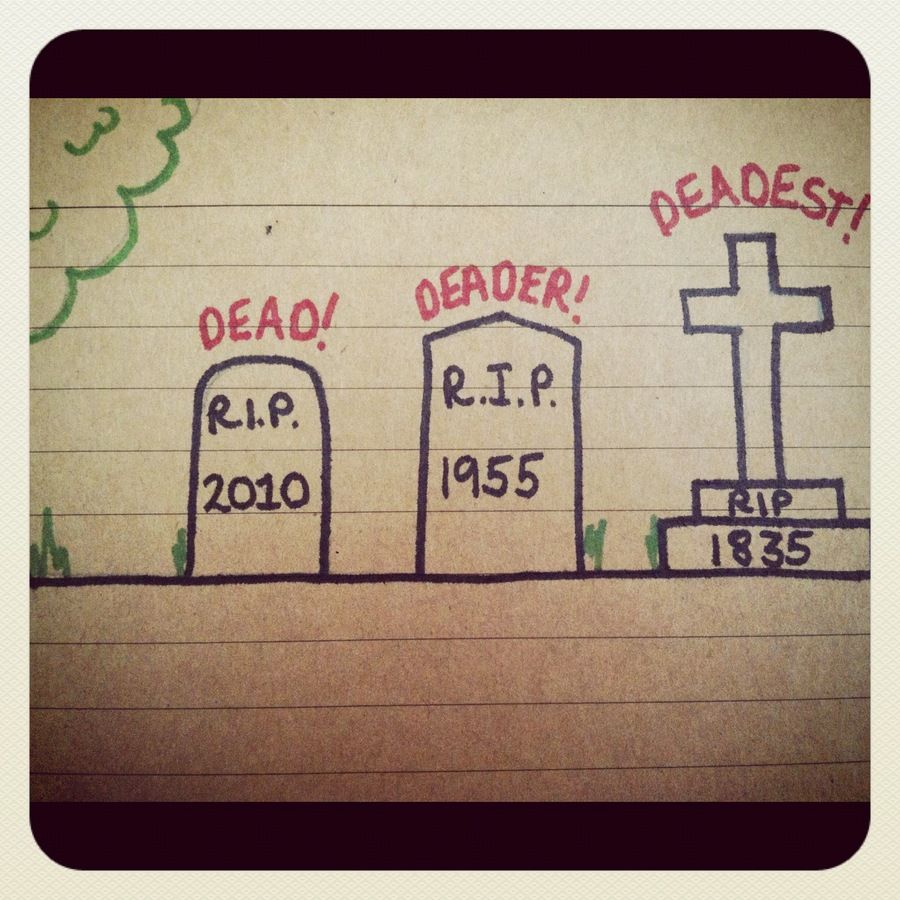
Just as we can’t say a person is more dead, we can’t say someone is more ideal or most unique, least preferable etc.

Even as you get away with saying “more complete” in colloquial speech, try to avoid it in writing.

Can you spot the wrong adjectives and correct them in the following sentences?

  • He’s one of the best players in our team.
  • That’s the most impossible challenge yet.
  • Your voice is very unique.
  • He’s the most complete man I’ve come across.

Common Adjective Mistakes #5: Which is the shortest of these two routes?

Correction: Which is the shorter of these two routes?

Explanation: While comparing two things, you can only use the comparative degree of an adjective, not the superlative degree.

Common Adjective Mistakes #6: I want a simplistic life away from the busy city.

Correction: I want a simple life away from the busy city.

Explanation: Simplistic means treating a complex problem as it were very simple. For example, it’s too simplistic to think that climate change can be averted by growing trees.

Finally, here are some of the answers to the questions I asked earlier.

Answers:

  • Daniel is taller than Harry.
  • Sally is funnier than Linda is.
  • The pizza today tastes better than it did yesterday.
  • She looks prettier than her sister.
  • He’s one of the better players in our team.
  • That’s an impossible challenge.
  • Your voice is unique.
  • He’s the complete man I’ve come across.

Keywords: common adjective mistakes, adjective based error exercise, mistakes in the use of adjectives
7 years ago [postview]

Grammar

Can’t Have Been vs. Couldn’t Have Been: How to Use Them Correctly

When it comes to modal verbs — the verbs that express necessity or possibility — many learners find them rather confusing.

I’ve written a couple of posts on the correct usage of modal verbs before. In this guide, I’d like to share with you tips on how to use Can’t Have (Been) and Couldn’t Have (Been) correctly.

So, let’s get started.

Can’t Have (Been)

This is used for two reasons — first, to express a degree of certainty of an event in the past; second, to frame a conditional phrase for a past event.

Let’s see some examples:

✅ Bryan can’t have committed the crime as he was in another country at the moment of the murder.

✅ Sally can’t have been hungry as she had already had two regular pizzas a little while earlier.

In the above examples, the speaker is expressing a degree of certainty about the events. Evidently, the speaker is saying that there was no way Bryan committed the crime as he was elsewhere when the murder was committed.

Similarly, in the second example, the speaker is refusing to believe that Sally was hungry since she’d already eaten enough just a while ago.

As you can see, Can’t Have (Been) is used only when you’re referring to an event in the past. So, don’t let the “can’t” lead you to think it can be used in the present tense.

Couldn’t Have (Been)

This is used, broadly, in three different scenarios.

✅ Expressing Impossibility of a Past Event

✅ Expressing Hypothetical Conditions

✅ Expressing One’s Inability in the Past

Expressing the Impossibility of a Past Event

As with the Can’t Have (Been), Couldn’t Have (Been) can also be used to express the impossibility of a past event.

Here are some examples:

✅ They couldn’t have kept track of the exact time as the clock didn’t exist back in those times.

✅ Mary couldn’t have defeated her opponent as she didn’t have any formal training in boxing.

In the examples above, the speaker is talking about the impossibility of the outcome under a specific circumstance.

As you can see, both Can’t Have (Been) and Couldn’t Have (Been) are used to express the impossibility of a result in the past.

So, what’s the real difference in their usage?

While Can’t Have (Been) is used to refer to an incident in the near past, Couldn’t Have (Been) is used for an event that happened way back in the past.

Let’s use some examples for comparison:

✅ He’s been limping since this past week; he can’t have won the race yesterday at all.

✅ Her father couldn’t have been rich overnight; he came from a pretty humble background.

As you can see, in the first example, the speaker is talking about the impossibility of the outcome of an event that’s related to the near past.

On the other hand, in the second example, the speaker negates the probability related to an event occurring in the remote past.

Expressing Hypothetical Conditions

Using Couldn’t Have (Been) to express a hypothetical condition is very common in everyday conversations. It’s typically used with “had (been)”.

For example: “I couldn’t have succeeded if she hadn’t offered any help.”

Of course, you can also say, “I couldn’t have succeeded without her help”.

The point is there’s a condition involved here.

REMEMBER: When “Couldn’t Have” is used as a past conditional, “Can’t Have” cannot be substituted, in any style.

For example: “Jon couldn’t have (Not Can’t Have) made it to the top without his support from his family.”

If you’re looking for more examples, please, read this guide on the conditional hypothesis.

Expressing One’s Inability in the Past

You can use “Couldn’t Have (Been)” to express your lack of ability, talent, skills in the past.

For example: “Sandra was talented enough to pass the grueling test; I know I couldn’t have made it.”

That’s it! I hope you enjoyed reading this guide and found it useful. Let me know if you have any questions!

Search Terms: can’t have meaning, can’t have done, couldn’t vs couldn’t have, could not have been grammar, couldn’t have been better meaning, can’t have sentences, couldn’t have been meaning, couldn’t of grammar

7 years ago [postview]

Grammar

When Do I Use “I” Instead of “Me?”

One of the most basic yet confusing rules of English grammar is the choice between “me” and “I”.

It’s one of those things that baffle many native English speakers let alone non-native English speakers.

So when someone asks you on the phone, “Is that you?”, how would you answer?

Well, to understand this better, let’s dive into the dynamics of English grammar.

There are a couple of things you should know upfront to better understand the rules and practice of English grammar.

Linking Verbs: Also called non-active verbs, linking verbs don’t describe an action. They simply describe a state of being. Some of the examples of linking verbs are “Am, Is, Are, Were”.

Pronouns: Pronouns are words that substitutes nouns or noun phrases. For example, we say “He/She is a great person” instead of “Bob/Mary is a great person” when we mention a person repeatedly in our speech.

Subject Case: Subject Case is the word that defines an object or a person. For example, It/This/I/They/We/He/She are subject cases in a sentence.

Object Case: Object Case is the word that occurs after a linking verb and often completes a sentence. For example, “She’s a girl” and “I’m Bob” where Girl and Bob are object cases.

As per traditional grammar rules, when a pronoun follows a linking verb, it should be in the subject case. For example:

  • It was I (not me) who started the fight. (where “I” remains unchanged)
  • It’s he (not him) who told me to be careful. (where “he” remains unchanged)
  • It’s they (not them) who took responsibility for the accident. (where “they” remains unchanged)
  • It’s we (not us) who care about you. (where “we” remains unchanged)

Nominative Case: When a noun/pronoun is used as a subject, it’s called Nominative Case. For example, Bob/He ate a hamburger. (Bob/He = Nominative Case)

Accusative Case: When a noun/pronoun is used as an object, it’s called Accusative Case. For example, Mary/She made our dinner. (Dinner = Accusative Case)

We use the nominative case while answering simple questions. For example:

Question: Who is there?
Answer: I’m here. (‘I‘ is a nominative case)

However, when the answer involves a personal pronoun (e.g. she/he/they/we), we tend to use the accusative case even though it’s not correct in formal grammar. For example:

Question: Who is it?
Answer: It’s me. (accusative case) | It’s I. (nominative case)

Predicate Nominative: The predicate nominative is a noun or pronoun that’s on the object end of a linking verb. We use predicate nominatives all the time. For example:

  • The lake was a frozen pool. (frozen pool = predicate nominative)
  • He’s Bob. (Bob = predicate nominative)

Most predicate nominatives are identical in their subject and object cases. However, many people get confused when predicate nominative involves personal pronouns because those have very different subject and object cases. For example, I and He are subject cases whereas ‘Me‘ and ‘Him‘ are object cases.

The rules of grammar say the predicate nominative should use the subject case even though it’s in the object position.

What does this mean?

This essentially means I (a personal pronoun) must remain I even when it takes the object position in a sentence. For example:

  • I am Bob ( where I = Personal Pronoun in Subject Case | Bob = Predicate Nominative in Object Case)
  • It is I (where It = Singular Pronoun in Subject Case | I = Predicate Nominative in Object Case)

Therefore, as per the strict rules of grammar, you should say, “It’s I,” rather than “It’s me,.”

Considering the strict grammar rules, you should also say the following things:

  • It’s we. (instead of It’s us)
  • It’s he. (instead of It’s him)
  • It’s she. (instead of It’s her)
  • It’s they. (instead of It’s them)

However, you’re not supposed to follow these rules in your everyday communications. In fact, old grammar rules were based on Latin grammar rather than English grammar.

Therefore, it’s more appropriate to use Me/He/She/We/They in your natural communications. Indeed, it has become the norm in the English language.

The Verdict

If you’re writing formal dialogue or in a formal setting, use “It’s I.”

However, you can (and it’s more appropriate to) use “It’s me.” in your everyday communications.

Keywords:

  • it’s me or it’s i
  • it’s me or this is me
  • it’s me or it’s i which is correct
  • it wasn’t me or it wasn’t i grammar
  • it’s me grammar rule
  • it wasn’t me or it wasn’t i grammar
  • it will be me or i grammar
  • it was not me or it was not i grammar
  • is it me or is it i which is correct english
  • it is me or it is i which one is correct
  • Me and i grammar rules

8 years ago [postview]

Grammar

When to Use “If I was” vs. “If I were”, Which One is Correct?

A lot of people use “If I was” instead of “If I were” when they use a subjunctive mood in a hypothetical situation.

Just so you know – this is wrong!

According to English rules, when you use a subjunctive mood in a hypothetical situation, you should use “If I were”.

What is a Subjunctive Mood?

The subjunctive mood is used in a hypothetical situation when you state something that is contrary to the fact.

In other words, when you wish for something that is simply not possible, or unreal, you use a subjunctive mood.

Here are some examples of Subjunctive Mood:

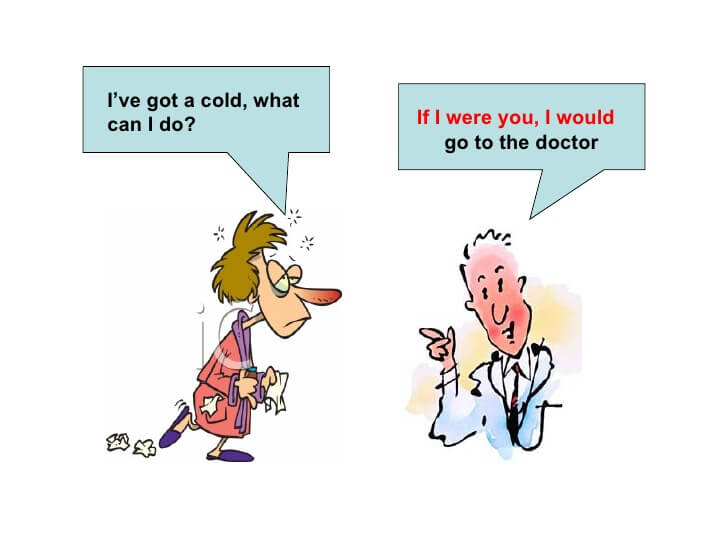
✅ If I were you, I would work harder.

✅ If I were your father, I would take good care of you.

✅ If you were my girlfriend, I’d never let you cry.

✅ If he were taller, he’d be accepted into the basketball team.

✅ If she were alive, she’d be super happy to see you succeed.

In all of these examples, the mood is subjunctive, meaning, the speaker is speaking of a hypothetical scenario that simply can’t be true.

Where Can I Use “If I Was”?

Based on the aforementioned argument, it’s possible to use “If I was” when something is not true at the moment, but it can be if the speaker tried.

For example:

If I was the captain of this team, we could win more matches.

Explanation: The speaker is a team member at the moment, but it’s very much possible that he could be the caption in future. It’s NOT unrealistic for him to lead the team in future.

Let’s consider a few more examples:

✅ If he was guilty of his actions, he’d apologize.

✅ If Rand was hardworking, he’d make more money.

As you can see, in these examples, we’re not talking about an unrealistic scenario. Therefore, “was” is more appropriate.

Be Careful of the Common Mistakes

There are many non-native speakers who tend to use “If I was” to explain their past actions.

Please, note that you absolutely cannot use “was” in a hypothetical scenario of the past. Instead, you should use “had been”.

For example:

Incorrect: If I was driving, you’d have felt safer.

Correct:

If I were driving, you’d feel safer. (If the speaker is talking of the present scenario.)

If I had been driving, you’d have felt safer. (If the speaker is talking about a scenario which has passed.)

Final Words

As you can see “If I were” is used only when it’s clear something is simply impossible, e.g., if I were a bird. Similarly, “If I was” is used when you presume a fair possibility of an event.

However, in practice, many purists still believe the speaker should stick to “were” if they were speaking of a situation that is currently untrue, e.g., if I were the captain.

On the contrary, many modern speakers believe it’s just a matter of choice. If you want to sound formal, use “were”.

8 years ago [postview]

Vocabulary

Fix Your Bloated Emails: Snip These Words

I have heard many people complain about bloated software on their smartphones – they call it “bloatware”. I have a feeling you don’t like it either. So, why do we dislike bloatware so much? Well, because it sits idle and eats up precious memory in your device, adding little or no value.

Involuntarily, we use a lot of bloatware in our daily writing too – words or phrases that add no value to the context of our writing, and potentially confuse the reader. From office emails to product descriptions to blog posts, nearly every piece of writing may contain superfluous words and phrases which reflect poorly on you.

So, let’s fix your bloated emails, shall we?

Words that Can Confuse/Offend Your Reader

There are some words in your emails that can potentially build a wrong impression about you. For example, “actually” can sound confusing, impolite, condescending, and sarcastic to some as it leaves opportunity for misinterpretation.

Here are some example:

  • The sky is actually blue.
  • You have to actually open the attachments to see my reports.
  • I actually fired him yesterday.

Explanation: “Actually” is a mere filler – a pause word that many people plug into a sentence while thinking of what to say next. This word may not be misconstrued in a face-to-face conversation because you see each other and understand the nonverbal cues. However, in written communications, that’s not the case which may lead to misinterpretation of your intention. Why reinforce the obvious when it can potentially lead to misunderstanding!

Words that Convey Hesitations

There are many words that convey your hesitations. We call them weasel words because they are often intentionally used to avoid answering questions clearly or deceive someone.

Here are seven weasel words that affect your credibility

Like: He’s like interested in your proposal.

Sort of/Kind of: I sort of know where you’re coming from.

Maybe: Maybe, I’m not sure.

Perhaps: Perhaps, we can ship your order by tomorrow.

Might: I might be able to complete the project by next week.

Can: I can see where you’re going with this.

Explanation: Excessive words of weasel words not only confuse the read but they make you very unprofessional. You don’t want to come across hesitant, unsure and dishonest in your communications. Before you send an email, take a moment to read out your draft aloud and see if any of your phrases or words make you sound self-doubtful.

Words that Add Nothing to Context

According to Henry James, “Adjectives are the sugar of literature and adverbs the salt.” Just as we need the right proportion of salt in a particular dish for it to taste delicious, we also need to use the right proportion of adverbs, as per the context, for the sentence to make sense and sound convincing. We don’t add salt to coffee because it doesn’t need any. Similarly, there are many contexts that don’t require any adverbs at all.

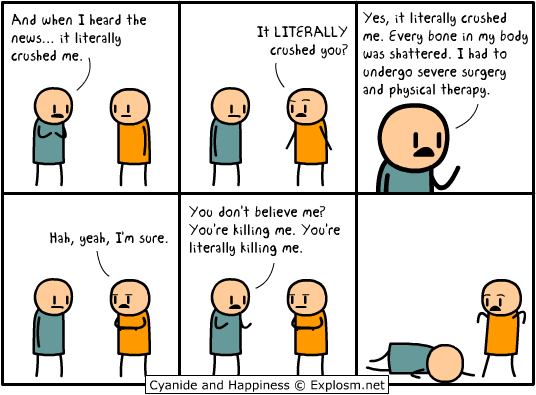
See the funny comics on “Literally” by The Oatmeal

There are many adverbs that are most abused in day to day speech as well as writing, such as “literally, practically, currently, basically and seriously.”

Literally: I literally fell off my chair laughing.

Practically: He practically came over to me.

Currently: I’m currently pursuing studies for the next one year.

Basically: Basically, I’m not interested in your proposal.

Seriously: I seriously consider your job offer.

Explanation: These words are extraneous and you can do without them. Imagine your email draft as a dish and see if it really requires a “spoonful of salt” to become more meaningful to your reader.

The Challenge

One of the most challenging aspects of writing emails (or any content pieces for that matter) is being clear, direct, and brief. Being prevalent in our everyday life, filler words tend to rub off on our writing more often than not. We must take extra care to edit our draft to make sure it sounds professional.

8 years ago [postview]

Vocabulary

Email Sign-off Best Practices: Avoid These Email Sign-Offs

Writing great emails is an art in itself. Whether you’re writing an email to an acquaintance you truly care about or a prospective employer for a job in their company, you really want to impress them.

However, it’s easier said than done. An email has several components and each one of them plays an equally important role in that it can make or mar the first impression.

In this post, our main focus is the email sign-off. Let’s take a look at the different ways you can sign off an email based on the context of the email and relationship you share with the recipient.

Nine Email Sign-offs that Never Fail

Formal Business Email Sign-offs

Regards: Although it’s a bit stodgy, it still works in professional email correspondences.

Sincerely: If you’re writing a cover letter, it adds a professional tone to your application. However, don’t use it for casual business emails.

Best Wishes: Many consider it as a safe bet for formal settings. However, you still need to see the context of your email and whether it fits the tone.

Friendly Business Email Sign-offs

Cheers: According to a study by Boomerang, “Cheers”, as an email sign-off, is likely to ensure a response. It works when the tone of your email is friendly and conversational.

Best: Many people use “Best” to convey best wishes in a cheerful way. However, it’s also too common to make your style stand out.

As Ever: It works for an ongoing business relationship and conveys that all is well between you and your recipient as they’ve ever been.

Gratitude & Requests Email Sign-Offs

Thanks in advance: The aforementioned Boomerang study also found “thanks in advance” had the highest response rate among all email sign-offs. It works apparently because the sender demonstrate gratitude towards the recipient. However, it also sets an expectation which can turn off a few depending on the context of your email. So, use it judiciously.

Thanks: Ending your email with “Thanks” means expression of gratitude but it also sets some expectation for the recipient in certain circumstances.

I appreciate your [help, input, feedback, etc.]: It’s a great way to thank your recipient if they have helped you in some way.

Nine Email Sign-offs to Avoid

Love: Use it strictly with people with whom you share a special bond, i.e, close friends, family members, or your significant other.

Thx or Rgrds: Avoid this instant messenger lingo.

Take Care: Don’t use it unless you know someone is in danger 😛

Looking forward to hearing from you: It might come off as passive-aggressive. Not a safe sign-off to go with.

Yours truly: This may sound like hokey and insincere unless you truly belong to the recipient.

Respectfully / Respectfully yours: Are you writing to a formal missive to the POTUS or to the President/PM of your country? It’s way to formal for any other setting. According to Business Insider, Respectfully yours is used a standard closing for addressing clergy or government officials.

Have a blessed day: It has religious overtones and not business appropriate at all.

[Nothing at all]: If you’re writing an email from your smartphone, you’re more likely to send an email without any sign-off unless you have specifically set up a standard sign-off for all emails sent from your smartphone. Either way, be careful.

-[Name] or -[Initial]: This may work informal emails only.

Sent from my iPhone/Samsung Galaxy: A lot of email apps will use your smartphone type as a default sign-off unless you edit and customize it as per your preference. The truth is many are just too lazy to do this.

Over to You

What’s favorite email sign-off? How do you deal with your default email signature while sending emails from your smartphones?

8 years ago [postview]

  • ← Previous
  • Page 1
  • Page 2
  • Page 3
  • Page 4
  • Interim pages omitted …
  • Page 6
  • Next →

© 2026 Common English Errors · Built on Genesis · Privacy Policy · Sitemap · Contact

This website uses cookies to ensure you get the best experience on our website.