
• Skip to primary navigation
  • Skip to main content

Common English Errors

Common Errors/Mistakes in English

  • Please Find Attached
  • Since 2 Years or For 2 Years?
  • Past Year or Last Year?

Vocabulary

Vocabulary

Adjective Word Order Exercises: Rules to Remember

As you know, adjectives are words that define the quality of nouns. Adjectives usually come before the noun although there are some exceptions to this standard rule.

But when you have to use to more than one adjective, you should follow the right order for the sentence to make perfect sense.

In this guide, I will share with you some easy-to-remember rules that will help you use the natural order of adjective easily. At the end of this guide, you will also have some adjective word order exercises for fun.

Rules of Natural Order of Adjectives

When you want to use multiple adjective before a noun, the first adjective should be the one that describes opinions or attitudes.

Other adjectives which are more factual or neutral by nature should come thereafter.

For example: “He’s an eminent American writer.”

Please, note that our focus on this sentence is to highlight his fame and popularity rather than his nationality.

Therefore, if we change the order of adjectives and say, “American eminent writer”, it doesn’t sound natural.

Here’s another example: “She’s one of the talented contemporary African American writers.”

When you don’t want to emphasize any particular adjective, play by the rules, and follow the natural order of adjectives.

Here’s a visual cheatsheet for your easy reference:
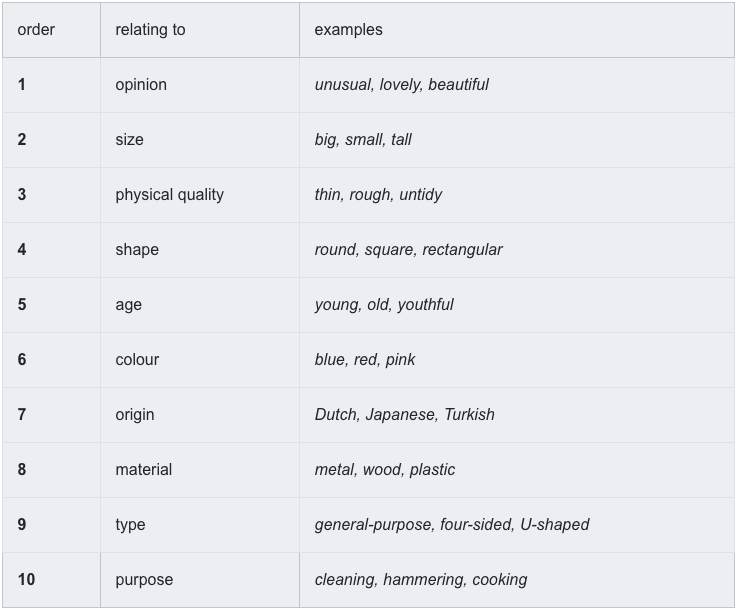
natural order of adjectives

Adjective Word Order Exercises

Okay, here are some questions if you want to test your understanding of the natural order of adjectives.

Luau is _____ party.

  • A traditional Hawaiian beach
  • A Hawaiian traditional beach
  • A traditional beach Hawaiian

A lei is a garland of _____ flowers and leaves typically worn around the neck.

  • Exotic colorful Hawaiian
  • Colorful exotic Hawaiian
  • Exotic Hawaiian colorful

My favorite _____ shirt was made in China.

  • Old black cotton
  • Cotton old black
  • Black cotton old

At Kuala Lumpur airport, I bought _____ hat.

  • A beautiful French red and
  • A beautiful red and white
  • A French beautiful red and

The students came out of the cathedral in their _____ cloaks and their _____ pinafores.

  • Scarlet bright; clean white
  • Scarlet bright; white clean
  • Bright scarlet; clean white
  • Bright scarlet; white clean

A ukulele is a ______ instrument, which resembles a guitar.

  • Small Hawaiian musical
  • Small musical Hawaiian
  • Hawaiian small musical

My grandmother kept her family photos in a _______.

  • Black small wooden
  • Small black wooden
  • Small wooden black

In our new apartment we have some ______ furniture.

  • Exotic old Italian
  • Italian lovely old
  • Old Italian exotic

Answers

A traditional Hawaiian beach

Exotic colorful Hawaiian

Old black cotton

A beautiful red and white

Bright scarlet; clean white

Small Hawaiian musical

Small black wooden

Exotic old Italian

Keywords: adjective word order exercises, natural order of adjectives
7 years ago [postview]

Vocabulary

Fix Your Bloated Emails: Snip These Words

I have heard many people complain about bloated software on their smartphones – they call it “bloatware”. I have a feeling you don’t like it either. So, why do we dislike bloatware so much? Well, because it sits idle and eats up precious memory in your device, adding little or no value.

Involuntarily, we use a lot of bloatware in our daily writing too – words or phrases that add no value to the context of our writing, and potentially confuse the reader. From office emails to product descriptions to blog posts, nearly every piece of writing may contain superfluous words and phrases which reflect poorly on you.

So, let’s fix your bloated emails, shall we?

Words that Can Confuse/Offend Your Reader

There are some words in your emails that can potentially build a wrong impression about you. For example, “actually” can sound confusing, impolite, condescending, and sarcastic to some as it leaves opportunity for misinterpretation.

Here are some example:

  • The sky is actually blue.
  • You have to actually open the attachments to see my reports.
  • I actually fired him yesterday.

Explanation: “Actually” is a mere filler – a pause word that many people plug into a sentence while thinking of what to say next. This word may not be misconstrued in a face-to-face conversation because you see each other and understand the nonverbal cues. However, in written communications, that’s not the case which may lead to misinterpretation of your intention. Why reinforce the obvious when it can potentially lead to misunderstanding!

Words that Convey Hesitations

There are many words that convey your hesitations. We call them weasel words because they are often intentionally used to avoid answering questions clearly or deceive someone.

Here are seven weasel words that affect your credibility

Like: He’s like interested in your proposal.

Sort of/Kind of: I sort of know where you’re coming from.

Maybe: Maybe, I’m not sure.

Perhaps: Perhaps, we can ship your order by tomorrow.

Might: I might be able to complete the project by next week.

Can: I can see where you’re going with this.

Explanation: Excessive words of weasel words not only confuse the read but they make you very unprofessional. You don’t want to come across hesitant, unsure and dishonest in your communications. Before you send an email, take a moment to read out your draft aloud and see if any of your phrases or words make you sound self-doubtful.

Words that Add Nothing to Context

According to Henry James, “Adjectives are the sugar of literature and adverbs the salt.” Just as we need the right proportion of salt in a particular dish for it to taste delicious, we also need to use the right proportion of adverbs, as per the context, for the sentence to make sense and sound convincing. We don’t add salt to coffee because it doesn’t need any. Similarly, there are many contexts that don’t require any adverbs at all.

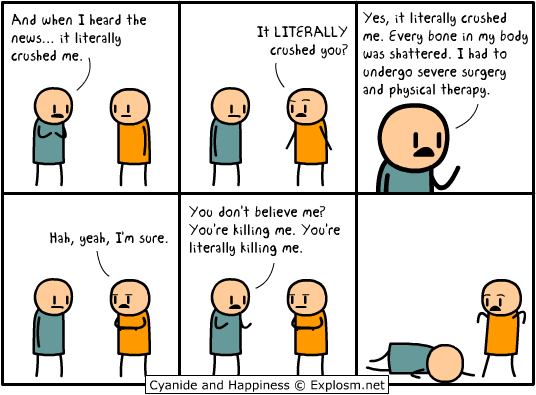
See the funny comics on “Literally” by The Oatmeal

There are many adverbs that are most abused in day to day speech as well as writing, such as “literally, practically, currently, basically and seriously.”

Literally: I literally fell off my chair laughing.

Practically: He practically came over to me.

Currently: I’m currently pursuing studies for the next one year.

Basically: Basically, I’m not interested in your proposal.

Seriously: I seriously consider your job offer.

Explanation: These words are extraneous and you can do without them. Imagine your email draft as a dish and see if it really requires a “spoonful of salt” to become more meaningful to your reader.

The Challenge

One of the most challenging aspects of writing emails (or any content pieces for that matter) is being clear, direct, and brief. Being prevalent in our everyday life, filler words tend to rub off on our writing more often than not. We must take extra care to edit our draft to make sure it sounds professional.

8 years ago [postview]

Vocabulary

Email Sign-off Best Practices: Avoid These Email Sign-Offs

Writing great emails is an art in itself. Whether you’re writing an email to an acquaintance you truly care about or a prospective employer for a job in their company, you really want to impress them.

However, it’s easier said than done. An email has several components and each one of them plays an equally important role in that it can make or mar the first impression.

In this post, our main focus is the email sign-off. Let’s take a look at the different ways you can sign off an email based on the context of the email and relationship you share with the recipient.

Nine Email Sign-offs that Never Fail

Formal Business Email Sign-offs

Regards: Although it’s a bit stodgy, it still works in professional email correspondences.

Sincerely: If you’re writing a cover letter, it adds a professional tone to your application. However, don’t use it for casual business emails.

Best Wishes: Many consider it as a safe bet for formal settings. However, you still need to see the context of your email and whether it fits the tone.

Friendly Business Email Sign-offs

Cheers: According to a study by Boomerang, “Cheers”, as an email sign-off, is likely to ensure a response. It works when the tone of your email is friendly and conversational.

Best: Many people use “Best” to convey best wishes in a cheerful way. However, it’s also too common to make your style stand out.

As Ever: It works for an ongoing business relationship and conveys that all is well between you and your recipient as they’ve ever been.

Gratitude & Requests Email Sign-Offs

Thanks in advance: The aforementioned Boomerang study also found “thanks in advance” had the highest response rate among all email sign-offs. It works apparently because the sender demonstrate gratitude towards the recipient. However, it also sets an expectation which can turn off a few depending on the context of your email. So, use it judiciously.

Thanks: Ending your email with “Thanks” means expression of gratitude but it also sets some expectation for the recipient in certain circumstances.

I appreciate your [help, input, feedback, etc.]: It’s a great way to thank your recipient if they have helped you in some way.

Nine Email Sign-offs to Avoid

Love: Use it strictly with people with whom you share a special bond, i.e, close friends, family members, or your significant other.

Thx or Rgrds: Avoid this instant messenger lingo.

Take Care: Don’t use it unless you know someone is in danger 😛

Looking forward to hearing from you: It might come off as passive-aggressive. Not a safe sign-off to go with.

Yours truly: This may sound like hokey and insincere unless you truly belong to the recipient.

Respectfully / Respectfully yours: Are you writing to a formal missive to the POTUS or to the President/PM of your country? It’s way to formal for any other setting. According to Business Insider, Respectfully yours is used a standard closing for addressing clergy or government officials.

Have a blessed day: It has religious overtones and not business appropriate at all.

[Nothing at all]: If you’re writing an email from your smartphone, you’re more likely to send an email without any sign-off unless you have specifically set up a standard sign-off for all emails sent from your smartphone. Either way, be careful.

-[Name] or -[Initial]: This may work informal emails only.

Sent from my iPhone/Samsung Galaxy: A lot of email apps will use your smartphone type as a default sign-off unless you edit and customize it as per your preference. The truth is many are just too lazy to do this.

Over to You

What’s favorite email sign-off? How do you deal with your default email signature while sending emails from your smartphones?

8 years ago [postview]

Vocabulary

Past Year vs Last Year vs Passed Year: Which One is Correct?

While talking about past events, many people can be found confused between past and last. Contrary to what many believe, past and last cannot be used interchangeably. They are used to describe different conditions of an event with regard to a particular period or phase of time.

Let’s take a look at the following examples.

  • I’ve been waiting for you for the last two hours. (incorrect)
  • I’ve been waiting for you for the past two hours. (correct)

But look at the following examples.

  • Although he started off really slow, he managed to catch up with the goal in the last three sessions. (not past three sessions)
  • Although he bowled quite badly at the beginning of the innings, he managed to pick up five wickets in the last two overs. (not past two overs)

The Explanation

Last: We use last when we want to talk about a period of time which is the final phase of a certain activity or event.

Past: We use past when we want to talk about a period of time that has just gone by recently.

So, if you’re talking about waiting for someone (as shown in the examples above), it’s correct to use the past two hours since you mean the period (two hours) that has just gone by.

You cannot use the last two hours since it’s not a phase of any event. In fact, the only event here is waiting for two hours. In other words, those two hours are the period of time which has just gone by waiting for your friend.

Some more examples…
In his last three years, he wrote two biographies. (described to talk about a person who has passed)

Last Year vs Past Year

Last year means the last calendar year, for example, 2015 (if you’re in 2016).

Past year means the 365 days preceding today. For example, if it was 14th Feb, 2016 today, then the past year would mean the time between 15th Feb, 2015 and 14th Feb, 2016.

For example:
He completed his MBA last year (for example 2015) but he’s been looking for a job for the past year. (for example, from 4th of July, 2015 until 3rd of July, 2016)

This Passed Year vs This Past Year

One of the most incorrectly used phrases in English is “this passed year”. Many users who commit this error believe “passed” has the same meaning as “past”, but that’s incorrect.

Here are some examples of incorrect usage:

  • You’re passed your bedtime. (incorrect)
  • You’re past your bedtime. (correct)
  • The popular actor past away. (incorrect)
  • The popular actor passed away. (correct)
  • He bought these shoes this passed weekend. (incorrect)
  • I bought these shoes this past weekend. (correct)
  • He walked passed the danger line. (incorrect)
  • He walked past the danger line. (correct)
  • The Uber drove passed its destination. (incorrect)
  • The Uber drove past its destination. (correct)
  • Sam got passed the finish line in record time. (incorrect)
  • Sam got past the finish line in record time. (correct)

Explanation

As you can see “Passed” and “Past” both share the same sound and this is probably why “passed” is often incorrectly used.

Grammatically speaking, ‘pass’ is a verb that has a range of meanings depending on the context. Let’s take a look at a few examples below:

  • Sandra passed the exam with distinction. (succeed in a test, past tense)
  • I’ve passed your notes to your friend. (hand over, present perfect)
  • My boss passed by me without giving me a glance. (go past something)
  • Sometimes I feel life is passing me by. (leave someone behind)

As you can see in the third example mentioned above, ‘passed’ often can mean to “move past” and indicates the motion of a person or an object.

Similarly, the word “past” has a wide range of meanings including ‘time before the present.

For example:

  • She has achieved a lot in the past two years. (adjective)
  • There’s no point in looking at your past. (noun)

However, ‘past’ can also be used as an adverb or a preposition as well.

For example:

  • He ran past. (beyond, adverb)
  • Mike walked past the door. (beyond, preposition)

This is exactly where many get confused and end up saying “passed” when they actually mean “past”.

It can be confusing for many since, in some cases, both variations are possible.

Look at the following examples:
You have passed the bedtime = You are past the bedtime.
However, in natural speech or writing, it sounds awkward to say, “you have passed the bedtime”.

What did we learn?

Whenever you’re confused about whether “he walked past or passed the door”, remember “walk past” as a phrasal verb.

Similarly, don’t say “this passed weekend” when you mean to say “this past weekend”.

Confused about whether she will “get past or passed the finish line”? Apply the same logic as advised in the first example.

I hope this post clarifies your doubts. If you find this post useful, share it with your friends.

9 years ago [postview]

Vocabulary

What the Heck is a Flagship Smartphone?

The prevalent misuse of “Flagship” among tech journalists in the context of the release of new smartphones has made it difficult for many English learners to comprehend the actual meaning of the word.

In this post, I will try to clear the confusion surrounding the word once and for all. Take my word for it.

Taylor Martin, a former tech journalist from the popular tech publication, Pocketnow tried to answer one of the most frequently asked questions in the smartphone world.

What does the word “Flagship” really mean?

While I highly recommend the article, I’ll try to briefly rephrase his words for those who are just too lazy to read the post.

The word “Flagship” originated as a naval term to denote the most prominent or important vessel in a fleet or ship carrying the commander. In the tech media world, the word is supposed to be used for the most expensive and high-end smartphone from a company.

Wikipedia defines the term “flagship” as the best or most important things owned or produced by a particular organization.

So typically, a flagship is almost unanimously considered the biggest product, largest, and most important single item in a group of products from a company.

However, the word has been tossed around so carelessly that it has come to lose its meaning altogether, confusing many learners that follow tech publications regularly.

Consider the following examples:

What’s the best flagship of 2016?

The first affordable flagship from Samsung.

In the above examples, the term flagship is simply used as a synonym for “smartphone”, which is confusing and misleading in the strict sense of vocabulary.

Similarly, many tech journalists and bloggers tend to mention, “Flagship Smartphone” in their reviews. Basically, they simply mean “high-end” or “premium” smartphones. However, by their very definition and context, both are very different from each other.

For this very reason, one cannot just use the word “flagship” to describe smartphones that are considered “budget” or “affordable” by the company.

For example, Apple released two smartphones – iPhone 6s and iPhone 6s Plus – in 2015. Going by the semantics, you can describe the iPhone 6s to be Apple’s flagship smartphone because it’s projected as a more visible and popular model from Apple.

In short, a “flagship smartphone” is supposed to be the one that commands the line of smartphones released by any manufacturer in a year.

When the term is used in a rather lenient way, it can also mean a particular smartphone model that a company intends to promote and sell more than any other models within its line-up, whether or not it’s the most expensive of the lot.

Note: If you want to learn more about the phrase, follow this discussion on Quora.

9 years ago [postview]

Vocabulary

How to Use Sit and Seat in Sentences

Oftentimes, people tend to commit errors with regard to the use of Sit and Seat. Many people, especially in a non-English speaking country, tend to use Seat as a noun. However, there are situations where using Seat as a verb is necessary to convey the message appropriately. This is exactly what this post aims to do.

So, let’s take a look at how we could use Sit and Seat as verbs under a number of circumstances.

Example #1: I’d like to sit next to you, please!

Explanation: The speaker himself wants to sit next to the person she is speaking with.

Example #2: I’d like you to sit next to my father, please!

Explanation: The speaker is requesting a person to sit next to her father.

SEAT (verb)

Meaning #1: Arrange for (someone) to sit somewhere.

Meaning #2: To have or provide seats for

Example #1: Don’t worry; I’ll seat you next to your father.

Explanation: A lady is assuring her kid that she will help him sit next to his father. The kid can’t choose the seat himself and needs to help from his mom.

In the day-to-day speech, however, people tend to use sit more often.

For example:  Don’t worry; I’ll make sure you sit next to your father.

Example #2: The stadium seats about 7,000 people.

Explanation: The stadium has the capacity to accommodate 7,000 spectators.

I hope this helps!

10 years ago [postview]

  • Page 1
  • Page 2
  • Next →

© 2025 Common English Errors · Built on Genesis · Privacy Policy · Sitemap · Contact

This website uses cookies to ensure you get the best experience on our website.