
• Skip to primary navigation
  • Skip to main content

Common English Errors

Common Errors/Mistakes in English

  • Please Find Attached
  • Since 2 Years or For 2 Years?
  • Past Year or Last Year?

Grammar

Grammar, Trending

A List of Common English Mistakes Indians Make

There are many common English errors that are quite unique to Indians, blame it on their flawed learning process. Since English is a second language in India, many tend to maintain a casual approach towards using grammar and vocabulary in their everyday writing and speech. Moreover, many people learn English usages from their peers without actually verifying the accuracy, a behavior that leads to easy acceptance of quite a few wrong usages in their everyday speech and writing. As a result, you hear usages that are unacceptable in standard English.

Here’s a list of such common English errors for your reference.

Cope Up vs. Cope With

Using prepositions with verbs loosely is one of the common mistakes Indians make.

Sample These:

How do you cope up?

I was stuck up in the traffic.

This tendency to use “up” indiscriminately with common verbs may have been influenced by common phrasal verbs such as break up, take up, wrap up.

Incorrect: You should learn how to cope up.

Correct: You should learn how to cope.

The verb ‘cope’ usually collocates with the ‘with’ preposition.

For example, you should say, “He should learn how to cope with the pressure.”

Here’s a discussion on Quora if want to learn more.

Many a Times vs. Many a Time

“Many a Time” is a fixed expression which is considered archaic these days. However, it is used by authors and publisher in literature.

“Many a Time” essentially means “Many Times”.

Speaking of rules of this archaic usage, any noun in front of “Many a” will take a singular form. Also, it’s usually used at the beginning of the sentence.

For example, “Many a soldier have fought the war.”

Please, read this answer for better understanding.

You Need Not to vs. You Need Not

Apart from being the main verb, need can also be a modal verb or auxiliary verb. When used a modal verb, it doesn’t take any preposition.

Modal verbs are used to indicate certainty, possibility or probability of an event.

Apart from need, there are many other common modal verbs you must be familiar with, such as can, could, may, might, will, would, shall, should, ought to, dare.

For examples:

  • He may not go home today.
  • You could ask him about his plans.
  • They ought to remember who their boss is.
  • Rand dare not enter my room while I’m still in.

There’s something common in all of the examples shown above – none of the modal verbs have taken any preposition.

Similarly, when used as a modal verb, “need” never takes a preposition.

Incorrect: You need not to say this.

Correct: You need not say this or you don’t need to say this.

Follow this link if you want to learn more about modal verbs.

Anyways vs Anyway

Because of the rampant use of the word “anyways”, many tend to believe this is just another alternative of “anyway” (adverb).

However, this is a wrong assumption.

Anyways is a non-standard colloquial variation of the word “anyway” which carries the following meanings.

  • I don’t know if it was lost or stolen; anyway, it’s gone. (In any case)
  • It was raining but they played the game anyway. (Regardless)
  • Anyway, Rand, I must dash. (Used to change the course of a topic)

FYI, anyways is universally regarded as being incorrect and unfit for print or publication. Therefore, you shouldn’t use it in formal writing or speech.

NB: You may have also come across the use of “Any Way” which is essentially a combination of two words – Any and Way.

For example: Will you be able help her in any way possible?

Here the word “any” (adjective) defines “way”. It’s not a variation of the word “Anyway”.

There’s a very useful article on this topic if you want to learn more about the difference.

Isn’t It? A Universal Question Tag

Question tags are some of the most confusing parts of learning English for many Indians.

Pro Tip: Questions tags are tag questions which are added to the end of declarative statements. For example, “You’re John, aren’t you?”

Question Tags follow a specific grammar pattern. They usually depend on the verb or auxiliary verb in a sentence.

Here are some examples:

  • It’s going to take a long time, isn’t it?
  • She has done really well in this test, hasn’t she?
  • They’re very excited about the new project, aren’t they?
  • Rand speaks like a professional, doesn’t she?
Note: Question tags can be different based on nature of the questions asked and intention behind the questions. Here’s a good source to learn more about rules of question tags.

However, many Indians tend to use “isn’t it?” no matter what the questions are.

Here are some examples:

Incorrect: He really likes you, isn’t it?

Correct: He really likes you, doesn’t he?

Incorrect: You’ve paid the rent for July, isn’t it?

Correct: You’ve paid the rent for July, haven’t you?

Incorrect: Rand is quite upset with his friend, isn’t it?

Correct: Rand is quite upset with his friend, isn’t he?

This image appeared in a slide show published on iTimes, a website owned by Times Internet Limited.

Revert Back vs Revert

This is something I’ve written about a few times in the past as well.

The problem lies in using “revert” in places where it doesn’t belong and then making it worse by adding “back” to it.

Going by its definition in dictionaries, “Revert” essentially means restoring something/someone to its previous/original state.

For example: After leaving the rehab, he reverted to his old drinking habits.

Moreover, “Revert” is an intransitive verb, meaning it doesn’t require a direct object to complete its meaning.

For example:

Incorrect: The magician said, “I’d vanish the rabbit in two seconds.”.

Correct: The magician said, “The rabbit will vanish in two seconds.”

In the same way, things or people revert to their old/original state or habits.

For example:

  • If you click on this option on your PC, the operating system will revert to its previous version.
  • She reverted to her old wicked ways.

Since “Revert” means “Going Back” to a previous state/condition, you don’t need to add “back” while using the world “Revert”.

Avoid Saying

  • I fear Rand will revert back to his smoking habits.
  • I suspect the computer program has reverted back to its previous build.

NB: While writing emails, many people tend to use “revert” or “revert back” when they mean to say “reply”. Many linguists believe this is wrong even as some online dictionaries have accepted this as an entry in email context.

CollinsDictionary.com has the following entry for Revert:

Revert: (US) (to reply to someone): We will revert to you with pricing and other details.

Recommend Reading: 6 Common English Vocabulary Errors and How to Avoid Them

To be continued…
9 years ago [postview]

Grammar, Trending

Avoid These Common Errors in Your Everyday Emails

The flaws in your grammar skills were unknown until you decided to become active on social media. Agree that it doesn’t make much of a difference as long as your followers get what you’re trying to say.

However, it’s not the same when you’re writing a business email – applying for a job or replying to your boss at work.

It’s true that many people tend to learn English usages and email etiquette from others. But, what if the person you often communicate with isn’t quite savvy with English grammar or usages?

As a matter of fact, this is the single most reason why business emails these days are replete with many common English errors such as “Please, revert back.”

You don’t want to let these common English mistakes ruin your image at work. So, beware of these errors and learn how to fix them in your email next time. [Read more…] about Avoid These Common Errors in Your Everyday Emails

9 years ago [postview]

Grammar

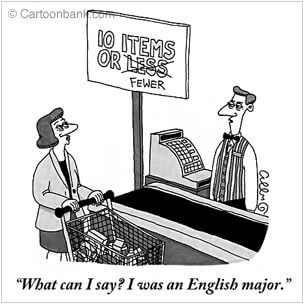
Little vs Less vs Fewer Examples: How to Use Them Correctly

At times, English can be extremely confusing to people who don’t use it as their first language. There are many instances of wrong usages which lead to wrong conclusions. The users may not be aware of the mistakes because they are not familiar with the nuances of the usages.

Almost every day, I see people use less instead of little and less instead of fewer. So, I have decided to point out the mistakes and clarify the confusion once and for all.

Little vs Less

Let’s take a look at the following examples:

Wrong: I find it very difficult to manage my monthly expenses because I get less salary.

Right: I find it very difficult to manage my monthly expenses because I get little salary.

Explanation:

By the very definition, little refers a small size, amount or degree of something. Therefore, when you want to say the salary you get is inadequate or insufficient for your monthly expenses, the right word is use little and not less.

Moreover, you can use very to intensify the statement. For example, very little salary. (not very less salary)

Less is used to express inadequacy or insufficiency of something, but only in a comparative sense. So when you say less salary, it sounds like you’re comparing your salary with someone who gets more than you do. In fact, you are expected to use than when you use an adjective (little) in its comparative form (less).

For example:

He makes less money than her wife does.

The above statement doesn’t imply his salary is inadequate. It simply implies it is less in amount as compared to his wife’s salary. After all, adequacy is a relative term. Even if you make $200,000 per annum, it may not be sufficient.

Less vs Fewer

Let’s take a look at the following examples:

Wrong: There are less eggs in the fridge than you think.

Right: There are fewer eggs in the fridge than you think.

Explanation:

Technically, fewer is the comparative form of few which is used with countable, plural nouns. In other words, fewer refers quantities that can be counted individually.

For example: There were fewer students in school due to the stormy weather. (not less student)

Less is the comparative form of little which is used with uncountable, singular nouns. In other words, less is used for collective quantities that are not counted individually and for abstract characteristics.

For example: I’d like to put less salt in my soup. (not fewer salt)

aj4B3

Some more examples:

I used to make much less money two years ago.

I have fewer pairs of shoes than I used to have.

She left less than five minutes ago.

I have fewer perfume bottles than I used to have until a few years ago, and I tend to wear a lot less perfume at work these days.

Hope this helps clarify your doubts, and you make fewer mistakes while using little/less/few moving forward.

That was just an example. Honestly, I’d hope you didn’t make any mistakes at all.

References: My English Teacher | Stack Exchange

Fewer vs Less Examples

  • A school teacher would make less money than a school principal.
  • I’d visit my Rand’s house every weekend, but now we have less time.
  • There are fewer biscuits in the box than I had expected.
  • He has fewer friends in this town than his father.

Using Less/Fewer with OF

For example:

  • I wish you spent less of your salary on paying rent!
  • There are fewer of them at the school reunions each year.
  • Fewer of the students were on Facebook than we’d expected.
  • Does he still smoke a lot cigarettes these days? No, I smoke much less of those these days.

If the NOUN doesn’t have a DETERMINER, don’t use OF before nouns.

For example:

  • I’m eating less chocolate these days because I want to lose weight.
  • Fewer people in my gym have strictly balanced diets.
  • Danny has fewer employees than he needed to take up the big project.
  • If you think less time would’ve forced him to evacuate his room, you’re wrong.

Update: We’ve edited this article based on the feedback given by Andrew Evans. Please, see his comment below. For more explanation, please, follow this thread.

9 years ago [postview]

Grammar

For Two Years vs. Since Two Years: Which One is Correct?

Grammatically speaking, For and Since are both prepositions that can be used in a sentence to express a specific time or period of time depending on the context.

Many believe these prepositions can be used interchangeably but as a matter of fact, that’s not true.

In fact, this is one of the common English errors I’ve seen people commit while expressing themselves on social media websites.

So, what’s the difference between For and Since, and how do you use them correctly while talking about time?

Let’s see some examples:

Example #1:

Incorrect: I haven’t seen him for last week.

Correct: I haven’t seen him since last week.

Example #2:

Incorrect: She has been suffering from fever since past two weeks.

Correct: She has been suffering from fever for past two weeks.

Since – a Specific Point of Time

You use Since when you talk about a specific point of time in the past around which an event took place. In Example #1 above, “Last Week” is the specific point of time around which the person was last seen. Remember Whatsapp?

Some more examples:

✅ I’ve been missing you since you were gone.

✅ She’s been feeling a bit dizzy since yesterday.

✅ Have you been behaving this way since childhood?

✅ He’s been much better since he quit smoking.

✅ I’ve never liked her since the first time I saw her.

If you pay attention to the underlined phrases in the examples above, you will realize they are actually a specific of time and not a length or period of time.

Important: Note that we use “Perfect Progressive” tense in all of the above examples. That’s because we mean to talk about something which has been occurring from a specific point of time and hasn’t actually stopped happening as we speak.

Therefore, it’s imperative to use this tense every time you use Since to talk about a period of time.

For – a Period of Time in the Past

You use For when you want to talk about a period of time or length of time in the past from which an event has taken place. In Example #2 above, “Past two weeks” is the period of time for which the person has been suffering.

Some more examples:

✅ India hasn’t conceded a boundary for the last ten overs. (in Cricket)

✅ I’ve been meaning to tell you the truth for the past six months!

✅ The Government has been fooling its people for the past three years.

As you can see, the underlined parts in the above examples indicate a period of time, as against a specific point of time.

Important: Note that we use a “Perfect Progressive” tense in all of the examples above. This is because we talk about an event that has been happening for a period of time and it hasn’t stopped occurring yet.

How to Avoid Mistakes while using For vs Since

The trick is to understand what a particular phrase actually means before using the right preposition.

There are many situations that may confuse some learners, especially those who don’t use English as their first language.

For example, can you say which of the sentences below is correct?

I’ve been working on this task since a long time.

I’ve been working on this task for a long time.

Well, the second example is the right answer. However, if Google it, you will see this actually confuses many learners.

The reason is some “a long time” may appear like a specific point of time to some while many agree it’s only a period of time in the strict sense.

Even some users try to use “a long time ago” to mean a specific point in time. For example:

I’ve been living here since a long time ago.

However, it’s still not acceptable in Standard English because the point of time is not very specific here. Unless you specifically want to be secretive about the specific date, you should use for example, since 2010 (date) or last year to denote the specific time.

The good news is you can alter the sentence structure and use both Since and For as per your convenience depending on the message you want to send.

Sample This:

✅ Example #1: I’ve been standing in line for the past two hours.

✅ Example #2: I’ve been standing in line since it was very cold in the morning and ticket counter wasn’t open.

As you can see the second sentence makes a very strong argument.

Recommended Reading: Past Year vs Last Year: Which One is Correct?

9 years ago [postview]

Grammar

Why “Couldn’t Able to” is Incorrect and What You Should Say Instead

Whenever I read comments on Facebook posts on the newsfeed, I cringe at the silly errors they commit. With the growing internet consumption, people actually grow up reading blogs that are teeming with grammar errors.

One of those glaring examples is “couldn’t able to”.
For Example:

  • I couldn’t able to sleep last night.
  • So what’s wrong with the example above?

Let me explain…

To understand the use of ‘could’, one needs to understand the rules of ‘modal verbs’ in English.

Here’s the deal.

Both can and be able to can be used to explain the ability of a person, especially when they try to do something.

For Example:

  • I can answer that question = I am able to answer that question (sounds a little formal)
  • Similarly, here are some examples in which the speaker is talking about his/her ability in the past.
  • I could walk much faster when I was 15 = I was able to walk much faster when I was 15.

Moreover, when you talk about a situation in the past when you tried harder to achieve something and succeeded in it, then you usually use ‘was able to’ or ‘managed to’.

For Example:

The test was very tough; I was able to answer only four out of ten questions. (the speaker tried his/her best and could do only four)

OR

The test was very tough; I managed to answer only four out of ten questions. (managed to = was able to)

Note that you can also use the following sentence:

The test was very tough; I couldn’t do more than four out of the ten questions.

If you are wondering if you could use ‘I could do only four out of ten questions, then the answer is you can but it will explain the situation clearly enough.

In fact, this is the reason why they use ‘managed to’ or ‘was able to’ – it clearly says something was difficult.

Here are some more examples:

  • I managed to book three tickets for the show. (the speaker indicates difficulty)
  • She was able to clear the test on her fourth attempt. (the test must have been tough)

Now that the rules are clear to you, take a look at the sentence below:

I couldn’t able to sleep last night.

So, what’s wrong?

Sure, the speaker has mixed up two things here: couldn’t and able to whereas he should have used just one, for example:

Either: I couldn’t sleep last night. (they were partying hard in the neighborhood)

Or: I wasn’t able to sleep last night.

The next time you notice something writing  ‘can’t able to’ or couldn’t able to, just share this link with them.

More Resources: Learning English with BBC

9 years ago [postview]

Grammar

Why You Should Avoid “According to Me” Expression

It’s quite common to come across a lot of people use “According to me” when they simply want to say “In my view/opinion”.

So is the usage grammatically incorrect?

No, but it’s kind of funny. And, here’s why.

“According to” is usually used as a reporting device. It is used to attribute statements or thoughts to other sources/people, usually when you’re referring to a second or third person.

For example,

So, according to you, John was responsible for the fight, right?

According to John, you were the one who said it first.

Logically speaking, we don’t refer to others the say way as we refer to ourselves. When you’re the one speaking, you don’t have to treat yourself like a second or third person.

Therefore, it’d be appropriate to say “In my opinion/view” or “If you ask me/my opinion”, instead of invoking yourself as a second or third person.

According to some grammarians, “According to me” can carry a completely different context in certain situations. In fact, it can be used to imply oneself as an authority in the field of one’s practice. When used in this particular context, it can, however, be very different from “In my opinion”.

At least, it’s not advisable to say “According to me” in a formal conversation.

Note: “According to me” is one of the common usage errors that are particularly found in India since many people tend to learn English as a second language without grasping the nuances of the language. You wouldn’t find native speakers saying, “According to me”.

However, you can use “According to” in the following ways:

According to my counting, there were ten books on the shelf.

So the next time you hear someone say “According to me”, be sure to tell them what they actually mean or point them to this post. Just kidding!

9 years ago [postview]

  • ← Previous
  • Page 1
  • Page 2
  • Page 3
  • Page 4
  • Page 5
  • Next →

© 2025 Common English Errors · Built on Genesis · Privacy Policy · Sitemap · Contact

This website uses cookies to ensure you get the best experience on our website.