
• Skip to primary navigation
  • Skip to main content

Common English Errors

Common Errors/Mistakes in English

  • Please Find Attached
  • Since 2 Years or For 2 Years?
  • Past Year or Last Year?

Grammar

One Less Thing vs One Fewer Thing: Which One is Correct?

When it comes to the use of “little/less/few/fewer”, quite a few non-native speakers of English fumble, quite easily.

Indeed, the difference between “less/few” can confuse many learners of English. More often, the choice also depends on the context of the sentence.

For your information, I’ve already written an easy-to-follow guide on how to use “less vs few” without any confusion.

Speaking of context, take a look at the following examples, and pick the right alternative.

  • It’s (less/fewer) than three hundred kilometers from Mumbai.
  • It costs (less/fewer) than 60 dollars.
  • He’ll arrive here in (less/fewer) than 20 minutes.
  • Can you write the essay in 100 words or (less/fewer)?

If you think the answer is “fewer” in all of the examples above, I’m afraid it’s incorrect.

The right answer is “less”.

Note: The last example may be confusing to many as “words” is a countable noun. I highly recommend reading this post by Anne Curzan to understand the distinction better .
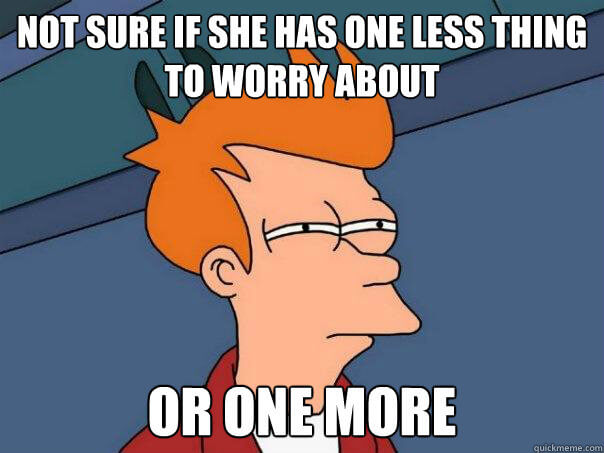
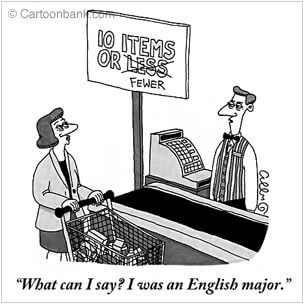
The reason is simple – even though we use “fewer” for countable nouns, here, as per the context, “three hundred kilometers, 60 dollars, 20 minutes, and 100 words” are more about distance, money, time, and length respectively. Therefore, we should use less rather than fewer.

There’s a strong reason why I cited these examples before discussing “one less thing vs one fewer thing” argument.

Okay, now, let’s take a look at the examples below.

  • I now have one less thing to worry about. (Correct)
  • I now have one fewer thing to worry about. (Incorrect)

A lot of non-native English learners tend to wonder if “one less” thing is incorrect since we’re talking about a list of challenges here.

However, the logic is quite different here.

Let’s first discuss why “one fewer” would be incorrect.

As per the rules, “fewer” applies to more than one of something.

In the example above, we are only talking about “that one thing” and not a bunch of things. Hence, “fewer” is incorrect.

Why “One Less Thing”?

It has a lot to do with the context. When we talk about a list of things, we essentially mean that it’s an endless effort in the grand scheme of life. When you imagine the list of tasks you must accomplish in your entire life, it’d seem virtually immeasurable. In other words, it’s like time or distance. Hence, it’d be “less” rather than “fewer”.

There’s another way to explain our answer as well.

If you try to rewrite or interpret the sentence above, it would read like:

“I now have less to worry about, by one thing”. (Sounds Right)

If we try to replace “less” with “fewer” in this sentence, it would read like:

“I now have fewer to worry about, by one thing”. (Sounds Strange)

One Less Thing vs One Thing Less

If you’re wondering if you should use “one less thing” or “one thing less”, rest assured both are correct. However, “one less thing” is more common than “one thing less”.

So, here’s the recap of what we’ve discussed in this guide so far.

  • I now have one less thing to worry about. (Right)
  • I now have one thing less to worry about. (Acceptable)
  • I now have one fewer thing to worry about. (Wrong).
  • I now have one thing fewer to worry about. (Wrong)

Let me know if you have any questions.
8 years ago [postview]

Grammar

Visited vs Have Visited vs Had Visited: How to Use Them Correctly

Are you a non-native English speaker, confused between “visited vs. have visited”? This post will help you understand the grammar rules once and for all.

Using correct tense is an important part of every business communication as it reflects your personality, especially when you’re communicating with someone who is well-versed in the English language.

It’s quite common to find many non-native English users confusing “past tense” with “present perfect tense”.

So, let’s take a look at some examples below:

❎ I have visited the doctor this past week. (wrong)

❎ Have you met your mother yesterday? (wrong)

So, what do you think is wrong with these examples?

Explanation: This is a pretty common error in Asian countries where English communication is largely affected by their mother tongue. Many non-English languages carry grammar rules which can be very different from the grammar rules we follow in the English language.

In the English language, when you describe an event that occurs in the past, i.e. yesterday or last week, you essentially use the “past simple” tense of the verb.

In the examples above, “yesterday” and “this past week” are both “adverbs”, meaning they define the nature of the verb that precedes them.

In the first example, the speaker talks about an event (visiting the doctor) with information about its occurrence (this past week).

Please, note that the “timing of the event” (or time adverb) is of utmost importance here, which decides the “tense form” the verb must take in the sentence.

Here, “this past week” refers to an event that clearly occurred in the past. Therefore, the event itself (visiting the doctor) must take “the past simple tense”.

Hence, it would be right to express yourself in the following way.

I visited the doctor this past week.

Similarly, the correct version of the second example would be:

Did you visit your mother yesterday?

To make it even clearer for you, here’s how you should break the sentences to understand which tense they should take.

I + visited + the doctor + this past week

Visited = the “past simple tense” of the verb “visit”.

This past week = the adverb denoting “timing of the event”.

Know Your Adverbs

It’s important to know your adverbs well enough in order to form correct sentences, using the appropriate tense.

Let’s consider a few examples with different adverbs.

Now, Currently, Right Now, Today

You can use either present continuous or present perfect tense with these verbs. However, you can never use “past simple” with these.

For example, the following examples would sound plain stupid:

❎ He was unemployed currently. (incorrect)

❎ He’s unemployed currently. (correct)

❎ Was he sick right now? (incorrect)

❎ Is he sick right now? (correct)

❎ I came here today. (incorrect)

❎ I’ve come here today. (correct)

However, there are some “adverbs” that can take both “past tense” as well as “present perfect tense” depending on the context.

Here are Some Examples:

✅ Example #1: I have purchased a CD player recently. (present perfect tense)

✅ Example #2: I purchased that CD player recently. (past simple tense)

Oxford Dictionary defines “recently” as an adverb denoting “at a recent time” and “not long ago”.

Explanation:

In Example #1, we are using a perfect tense in order to name the action as the source of the present state. Whereas, in Example #2, we are using a past tense since the action is one of a sequence of past actions, a narrative.

Please, keep in mind the present perfect is a present tense, which makes a statement about the situation at the time of speaking.

However, the following example would be incorrect.

❎ I have purchased that CD recently.

This is because when you are talking about purchasing “that CD”, you have presumably purchased it in the past. Therefore, you should rather say, “I purchased that CD recently”.

Visited vs Had Visited

Believe it or not, many non-native English users find it hard to differentiate between past simple tense and past perfect tense. They often wonder if the two could be used interchangeably.

The truth is both these tenses offer different contexts to the event. Take a look at the following examples:

  • Example #1: I visited my doctor yesterday.
  • Example #2: I had visited my doctor yesterday.

Which of the above examples is correct?

Answer: The first one.

Explanation:

We use past tense when the time is specified, e.g. yesterday.

We use past perfect tense only when we refer to another event (a concurrent event) in the past. In other words, it must carry some context – “what happened after you visited the doctor yesterday?”

For example:

I had watched television yesterday when it was time to go to bed.✅ Activity in the past = “it was time”.

✅ Activity before the past = “had watched television”.

I had watched television yesterday, by the time my parents came back.

✅ Activity in the past = “my parents came back”.

✅ Activity before the past = “had watched television”.

In short, without any context to “the other activity” that was done after watching television, using “had watched” would be incorrect.

Therefore, if you only mean to mention “watching television” in the past, simply say, “I watched television yesterday”.

I hope this helps. Please, let me know if you have any questions.
Source: Stack Exchange and Quora

8 years ago [postview]

Grammar

How to Write Effective Business Emails at Work

There’s a difference between writing emails to friends and writing emails to your boss at work.

It’s the quality of grammar and correct spelling, and tone that matters a lot in business email writing.

We tend to be laid-back while writing emails to friends and family because it’s a casual or semi-casual communication –  there’s nothing to lose if they find a few errors.

However, you can’t afford to do so when, for example, you’re applying for a job to your prospective employer.

Unfortunately, a lot of people don’t really write their business emails seriously enough even when they know it’s crucial to their job. Many don’t even know how to write a proper business email.

Here’s in this article, I’m going to share with you a few tips which will help you write proper business emails without committing any silly English errors.

First off, let’s look at an outline of a typical business email with different fragments.

  • Opening (informal greeting)
  • Referring to previous emails (format tone)
  • Stating the purpose of email (formal tone)
  • Making requests (formal tone)
  • Referring to attachments (formal tone)
  • Promising actions (formal tone)
  • Closing (informal greeting)

Opening of a Business Email

The opening of a business email usually carries an informal or casual tone. For example:

Hey Rand,

I hope you’re doing well! / How was your weekend? / How was your day off? / Hope you had a restful weekend! / How are you doing today?

Referring to Previous Emails

Before stating the purpose of your email, relate it to any of your previous correspondences. It usually carries a formal tone. For example:

  • With regards to your request for a quote…
  • In reference to our telephone conversation last week…
  • Further to our discussion at the meeting yesterday…

Stating the Purpose of Your Email

After referring to the previous correspondence, you need to state the purpose of your email. It usually carries a formal tone. For example:

  • I’d like you to have a look at the quote.
  • I’m writing to share my ideas on the project.

Making Requests in Business Emails

If you’re requesting the recipient of something, you need to use a formal tone and articulate your voice to make the best impact possible. For example:

  • I was wondering if you could allow me a day off!
  • Could you please let me know the status of the project?
  • It’d be great if you could keep me informed on the progress!

Referring to Attachments

This is one of the most crucial parts of business emails. Many tend to phrase their sentences incorrectly while referring to attachments.

I’ve written a very comprehensive post on how to refer to email attachments.

Here are some examples:

  • Please, see the attached report for your easy reference!
  • Kindly, review the attached proposal and let me know your thoughts!
  • Could you approve the attached quote!

Promising Actions

Depending on the context of your email, you can promise some action in order to set an impetus to your communication. You should usually use a formal tone here. For example:

  • I’ll get back to you after reviewing your proposal.
  • I’ll keep you posted on the progress of the project.
  • I’ll let you know the status of your interview by next week.

Closing a Business Email

You can close a business email with a casual or informal tone. This is a business courtesy. For example:

  • Have a great weekend!
  • Enjoy your day off!
  • All the best!
  • Keep up the great work!

Note: Remember to sign off your business emails in the following ways:

  • Thank You or Thanks
  • Cheers
  • Regards or Warm Regards
  • Take Care

Avoid the Following Mistakes in Business Emails

The way you write your business emails reflects a lot of your professionalism. There are a number of online resources (including Google Search) to help you hone your email writing skills.

There are no excuses for making mistakes.

Let’s take a look at some business email writing mistakes frequently committed at workplaces.

Including Exclusive Pronouns

Today, the workplace ambience is increasingly becoming more politically correct than ever. Using male pronouns while referring to female recipients is highly uncalled for.

To avoid this, use “him/her” or “his/hers”.

However, with the emergence of non-binary pronouns, you need to be more careful about referring to genders. Here’s an insightful article on BBC.

Being Confused about Similar Sounding Words

There are quite a few similar sounding words that easily confuse many. However, when you write business emails in a professional environment, you should brush up your elementary grammar to avoid any confusion. Keep a list of those common mix-ups and learn how to avoid them while writing emails.

Learn the Difference Between:

  • It’s and Its
  • Between/Among
  • Loose/Lose
  • Their/There
  • Than/Then
  • Accept/Except

Using CAPS

Using all upper case is considered a lack of etiquette in the online world, unless, of course, you want to yell at someone.

Similarly, don’t use multiple exclamation points/ questions marks/ dots.

The following examples sound odd in business emails.

  • How are you doing????
  • Please, let me know the status of the project!!!
  • I’ll wait for your reply…

Proofread Your Business Emails

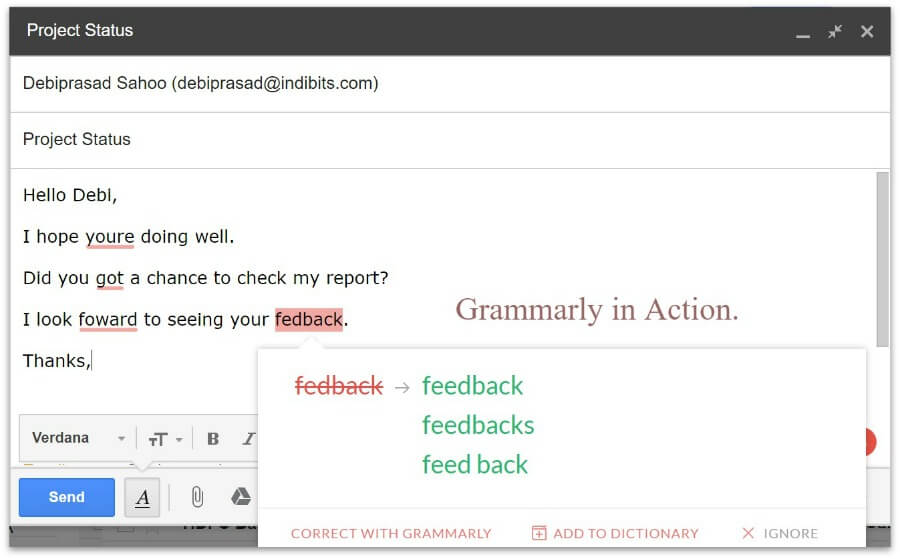
Always proofread your emails before sending them. Install Grammarly’s browser extension – I’ve found this extremely useful. The good news is it’s totally free!

Here’s a screenshot of Grammarly browser extension in action.

grammary-in-action

Grammarly is arguably the most effective online grammar checker in the world right now. It’s free to sign up for Grammarly.

Hope you find these tips useful for writing business emails. Let me know your thoughts and ideas in the comments below.

9 years ago [postview]

Grammar, Trending

A List of Common English Mistakes Indians Make

There are many common English errors that are quite unique to Indians, blame it on their flawed learning process. Since English is a second language in India, many tend to maintain a casual approach towards using grammar and vocabulary in their everyday writing and speech. Moreover, many people learn English usages from their peers without actually verifying the accuracy, a behavior that leads to easy acceptance of quite a few wrong usages in their everyday speech and writing. As a result, you hear usages that are unacceptable in standard English.

Here’s a list of such common English errors for your reference.

Cope Up vs. Cope With

Using prepositions with verbs loosely is one of the common mistakes Indians make.

Sample These:

How do you cope up?

I was stuck up in the traffic.

This tendency to use “up” indiscriminately with common verbs may have been influenced by common phrasal verbs such as break up, take up, wrap up.

Incorrect: You should learn how to cope up.

Correct: You should learn how to cope.

The verb ‘cope’ usually collocates with the ‘with’ preposition.

For example, you should say, “He should learn how to cope with the pressure.”

Here’s a discussion on Quora if want to learn more.

Many a Times vs. Many a Time

“Many a Time” is a fixed expression which is considered archaic these days. However, it is used by authors and publisher in literature.

“Many a Time” essentially means “Many Times”.

Speaking of rules of this archaic usage, any noun in front of “Many a” will take a singular form. Also, it’s usually used at the beginning of the sentence.

For example, “Many a soldier have fought the war.”

Please, read this answer for better understanding.

You Need Not to vs. You Need Not

Apart from being the main verb, need can also be a modal verb or auxiliary verb. When used a modal verb, it doesn’t take any preposition.

Modal verbs are used to indicate certainty, possibility or probability of an event.

Apart from need, there are many other common modal verbs you must be familiar with, such as can, could, may, might, will, would, shall, should, ought to, dare.

For examples:

  • He may not go home today.
  • You could ask him about his plans.
  • They ought to remember who their boss is.
  • Rand dare not enter my room while I’m still in.

There’s something common in all of the examples shown above – none of the modal verbs have taken any preposition.

Similarly, when used as a modal verb, “need” never takes a preposition.

Incorrect: You need not to say this.

Correct: You need not say this or you don’t need to say this.

Follow this link if you want to learn more about modal verbs.

Anyways vs Anyway

Because of the rampant use of the word “anyways”, many tend to believe this is just another alternative of “anyway” (adverb).

However, this is a wrong assumption.

Anyways is a non-standard colloquial variation of the word “anyway” which carries the following meanings.

  • I don’t know if it was lost or stolen; anyway, it’s gone. (In any case)
  • It was raining but they played the game anyway. (Regardless)
  • Anyway, Rand, I must dash. (Used to change the course of a topic)

FYI, anyways is universally regarded as being incorrect and unfit for print or publication. Therefore, you shouldn’t use it in formal writing or speech.

NB: You may have also come across the use of “Any Way” which is essentially a combination of two words – Any and Way.

For example: Will you be able help her in any way possible?

Here the word “any” (adjective) defines “way”. It’s not a variation of the word “Anyway”.

There’s a very useful article on this topic if you want to learn more about the difference.

Isn’t It? A Universal Question Tag

Question tags are some of the most confusing parts of learning English for many Indians.

Pro Tip: Questions tags are tag questions which are added to the end of declarative statements. For example, “You’re John, aren’t you?”

Question Tags follow a specific grammar pattern. They usually depend on the verb or auxiliary verb in a sentence.

Here are some examples:

  • It’s going to take a long time, isn’t it?
  • She has done really well in this test, hasn’t she?
  • They’re very excited about the new project, aren’t they?
  • Rand speaks like a professional, doesn’t she?
Note: Question tags can be different based on nature of the questions asked and intention behind the questions. Here’s a good source to learn more about rules of question tags.

However, many Indians tend to use “isn’t it?” no matter what the questions are.

Here are some examples:

Incorrect: He really likes you, isn’t it?

Correct: He really likes you, doesn’t he?

Incorrect: You’ve paid the rent for July, isn’t it?

Correct: You’ve paid the rent for July, haven’t you?

Incorrect: Rand is quite upset with his friend, isn’t it?

Correct: Rand is quite upset with his friend, isn’t he?

This image appeared in a slide show published on iTimes, a website owned by Times Internet Limited.

Revert Back vs Revert

This is something I’ve written about a few times in the past as well.

The problem lies in using “revert” in places where it doesn’t belong and then making it worse by adding “back” to it.

Going by its definition in dictionaries, “Revert” essentially means restoring something/someone to its previous/original state.

For example: After leaving the rehab, he reverted to his old drinking habits.

Moreover, “Revert” is an intransitive verb, meaning it doesn’t require a direct object to complete its meaning.

For example:

Incorrect: The magician said, “I’d vanish the rabbit in two seconds.”.

Correct: The magician said, “The rabbit will vanish in two seconds.”

In the same way, things or people revert to their old/original state or habits.

For example:

  • If you click on this option on your PC, the operating system will revert to its previous version.
  • She reverted to her old wicked ways.

Since “Revert” means “Going Back” to a previous state/condition, you don’t need to add “back” while using the world “Revert”.

Avoid Saying

  • I fear Rand will revert back to his smoking habits.
  • I suspect the computer program has reverted back to its previous build.

NB: While writing emails, many people tend to use “revert” or “revert back” when they mean to say “reply”. Many linguists believe this is wrong even as some online dictionaries have accepted this as an entry in email context.

CollinsDictionary.com has the following entry for Revert:

Revert: (US) (to reply to someone): We will revert to you with pricing and other details.

Recommend Reading: 6 Common English Vocabulary Errors and How to Avoid Them

To be continued…

9 years ago [postview]

Grammar, Trending

Avoid These Common Errors in Your Everyday Emails

The flaws in your grammar skills were unknown until you decided to become active on social media. Agree that it doesn’t make much of a difference as long as your followers get what you’re trying to say.

However, it’s not the same when you’re writing a business email – applying for a job or replying to your boss at work.

It’s true that many people tend to learn English usages and email etiquette from others. But, what if the person you often communicate with isn’t quite savvy with English grammar or usages?

As a matter of fact, this is the single most reason why business emails these days are replete with many common English errors such as “Please, revert back.”

You don’t want to let these common English mistakes ruin your image at work. So, beware of these errors and learn how to fix them in your email next time. [Read more…] about Avoid These Common Errors in Your Everyday Emails

9 years ago [postview]

Grammar

Little vs Less vs Fewer Examples: How to Use Them Correctly

At times, English can be extremely confusing to people who don’t use it as their first language. There are many instances of wrong usages which lead to wrong conclusions. The users may not be aware of the mistakes because they are not familiar with the nuances of the usages.

Almost every day, I see people use less instead of little and less instead of fewer. So, I have decided to point out the mistakes and clarify the confusion once and for all.

Little vs Less

Let’s take a look at the following examples:

Wrong: I find it very difficult to manage my monthly expenses because I get less salary.

Right: I find it very difficult to manage my monthly expenses because I get little salary.

Explanation:

By the very definition, little refers a small size, amount or degree of something. Therefore, when you want to say the salary you get is inadequate or insufficient for your monthly expenses, the right word is use little and not less.

Moreover, you can use very to intensify the statement. For example, very little salary. (not very less salary)

Less is used to express inadequacy or insufficiency of something, but only in a comparative sense. So when you say less salary, it sounds like you’re comparing your salary with someone who gets more than you do. In fact, you are expected to use than when you use an adjective (little) in its comparative form (less).

For example:

He makes less money than her wife does.

The above statement doesn’t imply his salary is inadequate. It simply implies it is less in amount as compared to his wife’s salary. After all, adequacy is a relative term. Even if you make $200,000 per annum, it may not be sufficient.

Less vs Fewer

Let’s take a look at the following examples:

Wrong: There are less eggs in the fridge than you think.

Right: There are fewer eggs in the fridge than you think.

Explanation:

Technically, fewer is the comparative form of few which is used with countable, plural nouns. In other words, fewer refers quantities that can be counted individually.

For example: There were fewer students in school due to the stormy weather. (not less student)

Less is the comparative form of little which is used with uncountable, singular nouns. In other words, less is used for collective quantities that are not counted individually and for abstract characteristics.

For example: I’d like to put less salt in my soup. (not fewer salt)

aj4B3

Some more examples:

I used to make much less money two years ago.

I have fewer pairs of shoes than I used to have.

She left less than five minutes ago.

I have fewer perfume bottles than I used to have until a few years ago, and I tend to wear a lot less perfume at work these days.

Hope this helps clarify your doubts, and you make fewer mistakes while using little/less/few moving forward.

That was just an example. Honestly, I’d hope you didn’t make any mistakes at all.

References: My English Teacher | Stack Exchange

Fewer vs Less Examples

  • A school teacher would make less money than a school principal.
  • I’d visit my Rand’s house every weekend, but now we have less time.
  • There are fewer biscuits in the box than I had expected.
  • He has fewer friends in this town than his father.

Using Less/Fewer with OF

For example:

  • I wish you spent less of your salary on paying rent!
  • There are fewer of them at the school reunions each year.
  • Fewer of the students were on Facebook than we’d expected.
  • Does he still smoke a lot cigarettes these days? No, I smoke much less of those these days.

If the NOUN doesn’t have a DETERMINER, don’t use OF before nouns.

For example:

  • I’m eating less chocolate these days because I want to lose weight.
  • Fewer people in my gym have strictly balanced diets.
  • Danny has fewer employees than he needed to take up the big project.
  • If you think less time would’ve forced him to evacuate his room, you’re wrong.

Update: We’ve edited this article based on the feedback given by Andrew Evans. Please, see his comment below. For more explanation, please, follow this thread.

9 years ago [postview]

  • ← Previous
  • Page 1
  • Page 2
  • Page 3
  • Page 4
  • Page 5
  • Page 6
  • Next →

© 2026 Common English Errors · Built on Genesis · Privacy Policy · Sitemap · Contact

This website uses cookies to ensure you get the best experience on our website.