• Skip to primary navigation
  • Skip to main content

Common English Errors

Common Errors/Mistakes in English

  • Please Find Attached
  • Since 2 Years or For 2 Years?
  • Past Year or Last Year?

Grammar

Grammar

Grammar Mistakes or Grammatical Mistakes? Using Attributive Nouns Correctly

During our conversation on Skype, a friend from Nevada interrupted me when I said, “They’ll conduct a second round of telephonic interview.”

He then apologized to me, saying, here in North America, we don’t say “telephonic interview”; “telephone interview” is more common here.

That made me super curious about the phrase and I started Googling just to see how people around the world (esp non-native English speakers) would use words in situations like this.

In fact, that’s the motivation behind this guide.

Grammar Mistakes or Grammatical Mistakes?

This is one of the many queries non-native English speakers are curious about.

Maybe they have been in a similar situation? Who knows!

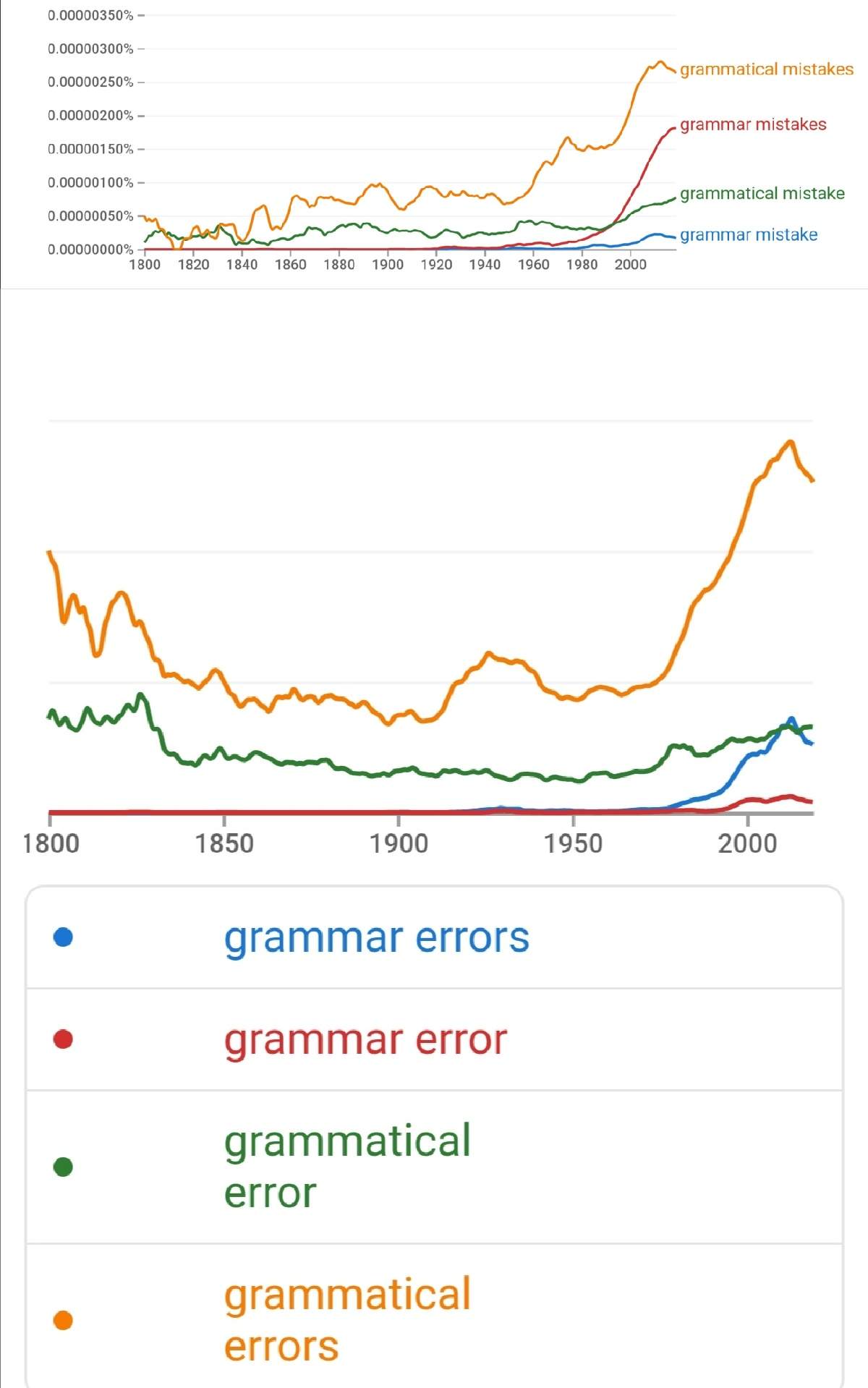
When you turn to Chat GPT for answers, it says both “grammar mistakes” and “grammatical mistakes” are grammatically correct, but they are used in slightly different contexts.

So, what are the contexts?
Grammar vs Grammatical Mistakes

Everyday Language vs. Formal Writing

“Grammar mistakes” refers to errors or inaccuracies in the use of grammar in written or spoken language. For example, using incorrect verb tense, subject-verb agreement, or punctuation.

“Grammatical mistakes” is a more formal term for the same concept. It also refers to errors in grammar usage but is often used in more technical or academic contexts.

In everyday language, “grammar mistakes” is more commonly used, while “grammatical mistakes” is frequently seen in formal writing or discussions about language and linguistics. Both phrases are correct, and the choice between them depends on the context and style of writing.

So, according to the Chat GPT explanation, it’s essentially a matter of specific use cases and scenarios. That makes perfect sense.

However, there’s another convention attached to this distinction.

Attributive Noun vs. Adjective

In the phrase “telephone interview”, both telephone and interview are nouns, but telephone performs the action of an adjective by attributing a nature to the interview.

In other words, it defines how the interview is conducted, ie. over the telephone.
When we say, “telephonic interview”, we essentially use the adjective instead of the attributive noun. So, it’s just an alternative to “telephone interview”.

In many countries such as India, however, the use of “telephonic interview” is very common among speakers (even in corporate offices).

Why is that? You may wonder!

Let’s just say Indian English is more formal or is it one of those common English mistakes Indians make?

Similar Guide: 6 Common English Vocabulary Errors and How to Avoid Them

This brings me to the next question – how do I use an attributive noun correctly?

How to Use Attributive Nouns Correctly

Attributive nouns are very common in everyday speech. Some examples are:

Music Class, Sea Food, Night Sky, Car Park, Country Road, Flight Tickets, Math Teacher.

While attributive nouns are a great and easy alternative to their adjective forms, they must be used judiciously.

In one of his blog posts, Ben Mudrak, an AJE author, cautions users to tread carefully in order to avoid causing confusion among readers.

Brevity is often paired with ambiguity, he quips.

For example, when you say, “voter awareness”, it could mean both of the following:

Awareness that voters are present
Awareness of a particular topic among voters

Likewise, when you add an adjective to an attributive noun, it could add to the confusion.

For example, a “small truck driver” could both mean a diminutive driver of a normal truck and a driver of a small truck)

Indeed, a good grasp of attributive nouns can help ward off such potential mistakes.

I hope this guide is useful to you.

2 years ago [postview]

Grammar

7 Grammar Errors that Drive British People CRAZY

Even as the English language is evolving and modern usages are making their way to universal acceptance, there are many usages that are still not correct by conventional rules.

In this guide, let’s take a look at the common English errors found mostly in the United Kingdom. There are many grammar mistakes and phrases that drive British people crazy. Well, not literally.

Let’s take a look:

“Of” instead of “Have”

Many people are in the habit of saying “of” after should/could incorrectly. It’s mostly true for people who have developed a habit of speaking by listening to others.

For example:
I would have told you about it. (Right)
I would of told you about it. (Wrong)

He should have tried harder. (Right)
He should of tried harder. (Wrong)

Can I get instead of Please, may/can I have

It’s interesting how phrases can have a varying degree of politeness in speech. While British people tend to use “Please” more often than not, North Americans are often more direct.

For example:
Please, may I get / can I get a coffee! (British)
Can I have / Can I grab a coffee! (American)

If you want to sound polite while asking for permission, you might want to use words such as “Please”, “May” or “Have”.

Mispronounce Letter H as Heytch

As an Indian, I have seen many people (especially IT professionals) mispronouncing the letter “H” as “Heytch”. As a result, they would pronounce words like “HD” as “Heytch Dee”, “HR” as “Heytch Aar”.

If you’re wondering where they picked it up, it’s probably their workplace where they worked with some British coworkers.

In the United Kingdom, many speakers tend to mispronounce the letter “H” (eytch) as “Heytch” which often gives their Indian friends the impression that it’s the right pronunciation.

Overuse of ‘Like’

Using “Like” as an emphasis is a common scenario among the British people, especially in everyday speech.

For example:
It’s like so annoying! (Wrong)
It’s so annoying! (Right)

Not only the British, but many Indians also tend to commit this error while speaking.

Was Sitting down / Sat down

It’s also common for many British people to say “I was sat down” when all they mean is “I was sitting down”.

For example:
I was sitting down / I was sitting on a bench. (Right)
I was sat down. / I was sat down on a bench. (Wrong)

Misuse of Reflexive Pronoun

Reflexive pronouns are some of the most misunderstood rules in English. Like many people around the world, British people also tend to make mistakes. Among all reflexing pronouns, “Myself” is the most commonly misused.

For example:
Myself and Tom will help you. (Wrong)
Tom and I will help you. (Right)

Yes, that’s myself. (Wrong)
Yes, that’s me (Right)

Using adjectives instead of adverbs

There’s a good deal of confusion when it comes to the difference between good and well. Good is an adjective while Well is an adverb. However, quite a few people (including British) tend to interchange them, especially in their everyday conversation.

For example:
He did good. (He did something positive)
He did well. (He did it nicely)

Note: When you say, “He did good”, you actually mean he did some good deed. On the contrary, “He did well” means he did something well, meaning his performance in something.

Question:
How are you doing today?

Answer:
I’m doing good. (Wrong)
I’m doing well. (Right)

Note: When you say, “I’m doing good”, it actually means you’re doing some good deed, e.g. giving loads to charity, your lunch to a homeless person.

Credit: English with Lucy (YouTube)

5 years ago [postview]

Grammar

9 Cringe-Worthy Grammar Bloopers Nearly Everybody Makes

Nearly all of us make some of these embarrassing grammar mistakes without even realizing it. Check out the list to see if you’re aware of these flubs.

Even the most image-conscious people commit grammar blunders in their day-to-day life. With incorrect words, spelling, and punctuation, many people leave a wrong impression on others. Make no mistakes — people often make assumptions about your education and intelligence based on your grammar and vocabulary. Here’s a list of the most common grammar mistakes nearly all of us make without being aware of them.

First-come, First-serve

First-come, First-serve

The idiom “First come, first served” essentially means a group of people or things will be dealt with or given something in the order in which they arrive.

By leaving the “d”, it suggests the person who arrives first will be the one who serves everyone. That’s funny!

I Could Care Less

I Could Care Less

When you say you “could care less”, you essentially mean you still have “some care” to be allocated to something. However, that’s not what you really want to say when you want to say you’re not bothered about something at all. Therefore, the right idiom is “I couldn’t care less”, which means you care about something the least.

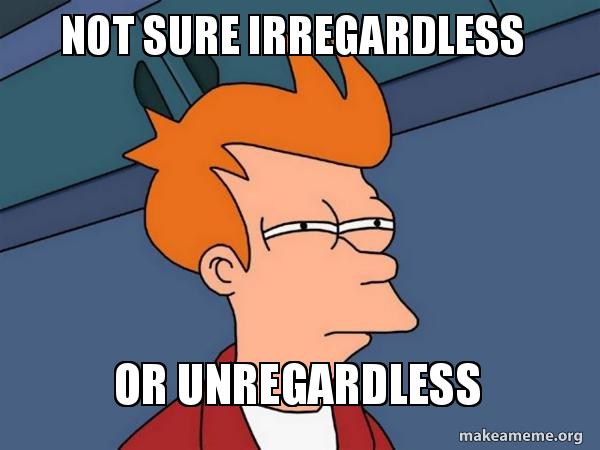
Irregardless

Irregardless

Regardless means without regard. For example, Sam will eat chocolate regardless of the consequences.

There are no such words as “Irregardless”. Avoid it or look silly!

“I” as the last word in a sentence

Many people tend to end their sentences with “I” when it should be “me”.

For example,

  • He spoke to Sandy and I. (Incorrect)
  • He spoke to Sandy and me. (Correct)

Whenever in doubt (I vs Me), the trick is to take the first person’s name out of the sentence and see how the sentence sounds with the personal pronoun left. In the above sentence, “He spoke to I” would sound odd.

Likewise, it’s incorrect to use “Me” in the beginning.

For example,

  • Me and Shelly met at the park earlier today. (Incorrect)
  • Shelly and I met at the park earlier today. (Correct)

Emigrated to

Speaking of immigration, there are two words that often confuse users — emigrate and immigrate.

Emigrate is always followed by “from” while immigrate always go with “to”.

For example,

  • Jacob emigrated from Australia to the United States.
  • Jacob immigrated to the United States from Australia.

In short, “to emigrate” is coming from somewhere while “to immigrate” is going somewhere.

Overuse of apostrophes

Unless you’re using texting or tweeting, it’s always important to use apostrophes in the correct way.

Broadly speaking, apostrophes play two vital roles in grammar: to indicate possession or shorted form.

For example,

  • Tom’s iPhone (Possession)
  • There’s (Shortened form of There is)

However, apostrophes are often overused.

For example,

  • FAQ’s (It should be FAQs)
  • The Thomson’s (It should be The Thomsons)
  • 1990’s (It should be the 1990s)

The first-year anniversary

The word year is redundant here — the “first anniversary” should suffice.

Subject and pronoun disagreement

The subject-pronoun agreement is one of the tricky affairs. The thumb rule says the pronoun should agree with the corresponding subject. However, many people tend to overlook this critical aspect.

Take a look at the following examples:

  • A person who smokes damages their lungs. (Incorrect)
  • A person who smokes damages his/her lungs. (Correct)
  • Those who smoke damage their lungs. (More correct)

In the first sentence, the subject (a person) is one person while the corresponding pronoun (their) represents a collective noun. Therefore, they don’t agree with each other. While the second sentence is correct, it’s not often the best way to say it. Therefore, the third sentence is more correct.

Overuse of “literally”

Literally means actually. You shouldn’t use it unless something actually happened. Many people, however, tend to exaggerate their expressions by overusing “literally”.

For example,

  • They’re literally moving mountains to win the trophy.
  • It was so boisterous that my head was literally exploding.
  • In his youth, Michael was literally a greyhound.
  • My school gym is like literally 500 years old.

Do you know any other bloopers worth adding to this list? Please, let me know in the comments below!

6 years ago [postview]

Grammar

So Do I vs. Me Too: Which One is Correct?

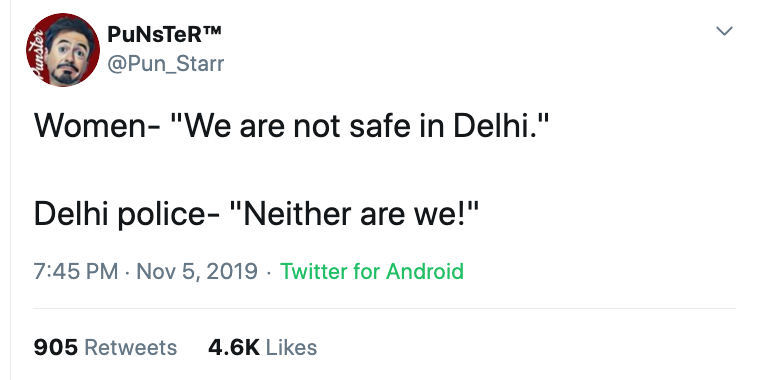
Recently, I came across the following tweet.

Women- "We are not safe in Delhi."

Delhi police- "We too."

— PuNsTeR™ (@Pun_Starr) November 5, 2019

Even as the tweet was retweeted over a thousand times, I was surprised to find nobody pointed out the glaring mistake.

Can you see the error in the above tweet?

That’s right — “We Too”.

In English communication, there is a convention to follow when you express your agreement/disagreement with someone.

For example:

I love ice-cream — So do I.
I am quite honest — So am I.
I have seen that movie — So have I.
I must leave now — So must I.
I would be surprised — So would I.

Note: You could also use “Me Too” instead of the above responses. However, “Me Too” is very informal in nature. So, be prudent considering the situation and context.

In all of the above examples, the speaker is talking about themselves. What if they were talking about someone else?

For example:

She’s always late — So is he.
He has many friends — So does she.

In the above examples, your response is about someone else. It’s important to note the agreement between “subject” and “verb” as well.

Agreeing with Negative Speeches

If the speaker is using negative speeches, your agreement should be negative too.

For example:

I don’t like politics — Neither Do I (Nor Do I in the UK)
I didn’t make it — Neither Did I (Nor Did I in the UK)
I’m not fond of Jazz — Neither Am I (Nor Am I in the UK)

Note: You can’t use “Me Too” as a response in agreement to the negative speeches. However, you can use “Me Neither” in informal communication.

Therefore, it’s wrong to say “Me Too” in response to the above examples.

Keeping the convention in mind, the tweet should have been as follows:

Agreeing with Negative Speeches

6 years ago [postview]

Grammar

How to Use Adverbs – A Handy Guide

Adverbs are words that modify the meaning of a verb or an adjective. Here are some examples:

  • He spoke loudly. (Adverbs of manner)
  • Please, come here! (Adverbs of place)
  • I’ll see you tomorrow. (Adverbs of time)
  • You should practice it twice. (Adverbs of frequency)

In the examples of above, the words that modify the meaning of the verb are adverbs.

  • Loudly modifies the manner in which he spoke.
  • Here modifies the place where I’m asking you to come.
  • Tomorrow modifies the time when I’m planning to see you.
  • Twice modifies the frequency with which you should practice it.

Types of Adverbs

  • Adverbs of Manner
  • Adverbs of Place
  • Adverbs of Time
  • Adverbs of Frequency

Adverbs of Manner: As illustrated above, words that answer how an action is performed, are categorized as adverbs of manner. For example, words such as carefully, quickly, beautifully and clearly define the verb in a sentence.

NOTE: Although many adverbs end with a ‘-ly’, not all words with a ‘-ly’ are adverbs. Some of them can be adjective also. Here are some examples of words that not adverbs.
  • This is a weekly magazine.
  • It’s such a ghastly act.
  • let’s go for a leisurely walk.
  • He’s such a friendly person.

List of Adverbs Not Ending in -ly

Similarly, many words remain the same whether you use them as adjectives or adverbs. Here are some examples:

We’re close friends. (adjective)
Andy stood close to the door. (adverb)

He didn’t have a fair chance to win this competition. (adjective)
I don’t think she played fair. (adverb, meaning she cheated)

He loves fast cars. (adjective)
I don’t want to drive fast. (not fastly) (adverb)

I want a straight answer (adjective)
He went straight to his office (adverb)

Adverbs of Place: Words that answer the question “where” are “adverbs of place”. Here are some examples:

  • Can you come downstairs!
  • Please, sit down!
  • I searched for you everywhere.
  • Keep it inside your bag.
  • Stay close to your father.

Adverbs of Time: Words that answer the question “when” are “adverbs of time”. Here are some examples:

  • I met him last year.
  • We’ve met before.
  • You need to start now.
  • I quit five years ago.

Adverbs of Frequency: Words that answer the question “how often” are “adverbs of frequency”. Here are some examples:

  • I saw him only once.
  • He always gets late for his bus.
  • She never wants to meet you.
  • She rarely checks her emails.

Using Multiple Adverbs in Correct Order

When a sentence takes multiple adverbs, it’s important to use them in correct order. Here’s an example:

I met him reluctantly at the college twice yesterday.

The above sentence has four adverbs such as reluctantly (manner), at the college (place), twice (frequency), and yesterday (time).

As per the rules (royal order of adverbs), adverbs should appear in the following order.

1. Manner
2. Place
3. Frequency
4. Time
5. Purpose

Here are some more examples:

  • I’d like to see you / in my cabin / in ten minutes.
  • Speak truthfully / in the courtroom / tomorrow.
  • She danced happily / at her wedding / yesterday.
NOTE: Unlike adjectives, you can alter the order of adverbs in order to convey a particular meaning.

Keywords: Adverb error questions, Adverb error sentences, Spotting error in adverb, the order of adverbs

7 years ago [postview]

Grammar

Are You Making These Common Adjective Mistakes?

While you can get away with these common adjective mistakes in a colloquial setting, they can cost you a lot in a professional environment, especially in job interviews.

Common Adjective Mistake #1: I’m not interesting in the movie.

Correction: I’m not interested in the movie.

Explanation: Many adjectives are formed by adding prefixes such as “-ing” or “-ed” to a verb. When an adjective ends with “-ing”, it describes the effect of a thing or person. Likewise, when an adjective ends with “-ed”, it describes how a person feels.

In the example above, the movie is a thing which doesn’t interest you. Therefore, the movie is not interesting to you. In other words, you’re not interested in the movie.

Common Adjective Mistake #2: The room smells awfully.

Correction: The room smells awful.

Explanation: Awful isn’t modifying the verb (smell) here, but the noun (the room).

However, you can write, “the room smells awfully funny.”

Here, “awfully funny” is an adjective phrase which goes after the linking verb smell.

Common Adjective Mistakes #3: He’s more stronger than his opponent.

Correction: He’s stronger than his opponent.

Explanation: This is a classic case of using Double Comparatives. When you use the comparative form of an adjective (stronger), there’s no need to use another adjective (more).

Can you fix the following adjective errors?

  • Daniel is more taller than Harry.
  • Sally is more funnier than Linda is.
  • The pizza today tastes more better than it did yesterday.
  • She looks more prettier than her sister.

Common Adjective Mistakes #4: You’re the most perfect person I’ve ever seen.

Correction: You’re the perfect person I’ve seen.

Explanation: Some adjectives are complete and absolute by themselves. We call them absolute or non-gradable adjectives. You can add any words to intensify or grade them further.

Here are some examples of absolute adjectives:

Supreme, Wonderful, Horrible, Brilliant, Final, Obvious, Unique, Absolute, Complete, Ideal, Preferable, Dead etc.

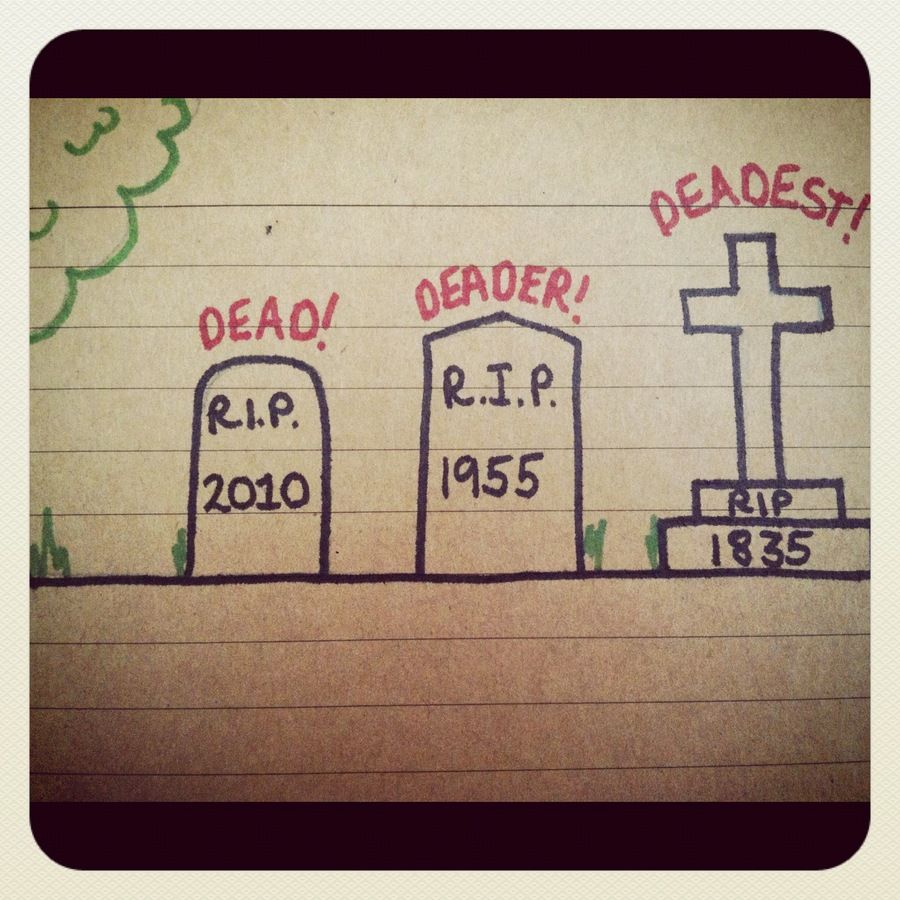
Just as we can’t say a person is more dead, we can’t say someone is more ideal or most unique, least preferable etc. It defies logic, to begin with.

Just as we can’t say a person is more dead, we can’t say someone is more ideal or most unique, least preferable etc.

Even as you get away with saying “more complete” in colloquial speech, try to avoid it in writing.

Can you spot the wrong adjectives and correct them in the following sentences?

  • He’s one of the best players in our team.
  • That’s the most impossible challenge yet.
  • Your voice is very unique.
  • He’s the most complete man I’ve come across.

Common Adjective Mistakes #5: Which is the shortest of these two routes?

Correction: Which is the shorter of these two routes?

Explanation: While comparing two things, you can only use the comparative degree of an adjective, not the superlative degree.

Common Adjective Mistakes #6: I want a simplistic life away from the busy city.

Correction: I want a simple life away from the busy city.

Explanation: Simplistic means treating a complex problem as it were very simple. For example, it’s too simplistic to think that climate change can be averted by growing trees.

Finally, here are some of the answers to the questions I asked earlier.

Answers:

  • Daniel is taller than Harry.
  • Sally is funnier than Linda is.
  • The pizza today tastes better than it did yesterday.
  • She looks prettier than her sister.
  • He’s one of the better players in our team.
  • That’s an impossible challenge.
  • Your voice is unique.
  • He’s the complete man I’ve come across.

Keywords: common adjective mistakes, adjective based error exercise, mistakes in the use of adjectives

7 years ago [postview]

  • Page 1
  • Page 2
  • Page 3
  • Interim pages omitted …
  • Page 5
  • Next →

© 2025 Common English Errors · Built on Genesis · Privacy Policy · Sitemap · Contact

This website uses cookies to ensure you get the best experience on our website.